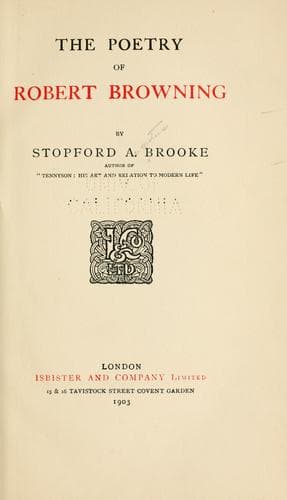
The poetry of Robert BrowningBrooke, Stopford A. (Stopford Augustus)
General
The poetry of Robert Browning
Brooke, Stopford A. (Stopford Augustus)
Browning, Robert, 1812-1889 -- Criticism and interpretation
Over the sea our galleys went,
With cleaving prows in order brave
To a speeding wind and a bounding wave,
A gallant armament:
Each bark built out of a forest-tree
Left leafy and rough as first it grew,
And nailed all over the gaping sides,
Within and without, with black bull-hides,
Seethed in fat, and suppled with flame,
To bear the playful billows' game.
It is made in a happy melody, and the curious mingling in the tale, as
it continues, of the rudest ships, as described above, with purple
hangings, cedar tents, and noble statues,
A hundred shapes of lucid stone,
and with gentle islanders from Græcian seas, is characteristic of
certain folk-tales, especially those of Gascony. That it is spoken by
Paracelsus as a parable of the state of mind he has reached, in which he
clings to his first fault with haughty and foolish resolution, scarcely
lessens the romantic element in it. That is so strong that we forget
that it is meant as a parable.
There is another song which touches the edge of romance, in which
Paracelsus describes how he will bury in sweetness the ideal aims he had
in youth, building a pyre for them of all perfumed things; and the last
lines of the verse I quote leave us in a castle of old romance--
And strew faint sweetness from some old
Egyptian's fine worm-eaten shroud
Which breaks to dust when once unrolled;
Or shredded perfume, like a cloud
From closet long to quiet vowed,
With mothed and dropping arras hung,
Mouldering her lute and books among,
As when a queen, long dead, was young.
The other is a song, more than a song, in _Pippa Passes_, a true piece
of early folk-romance, with a faint touch of Greek story, wedded to
Eastern and mediæval elements, in its roving imaginations. It is
admirably pictorial, and the air which broods over it is the sunny and
still air which, in men's fancy, was breathed by the happy children of
the Golden Age. I quote a great part of it:
A King lived long ago,
In the morning of the world,
When earth was nigher heaven than now:
And the King's locks curled,
Disparting o'er a forehead full
As the milk-white space 'twixt horn and horn
Of some sacrificial bull--
Only calm as a babe new-born:
For he was got to a sleepy mood,
So safe from all decrepitude,
Age with its bane, so sure gone by,
(The gods so loved him while he dreamed)
That, having lived thus long, there seemed
No need the King should ever die.
LUIGI. No need that sort of King should ever die!
Among the rocks his city was:
Before his palace, in the sun,
He sat to see his people pass,
And judge them every one
From its threshold of smooth stone
They haled him many a valley-thief
Caught in the sheep-pens, robber chief
Swarthy and shameless, beggar, cheat,
Spy-prowler, or rough pirate found
On the sea-sand left aground;
* * *
Public-domain text, read in full here on John Shaqi.
Reviews
Reviews
No reviews yet
Be the first to share your thoughts on this work.
Elsewhere in the archive
Join the Discussion
Join the discussion
Sign in to leave a comment or review.
Sign InorCreate an account