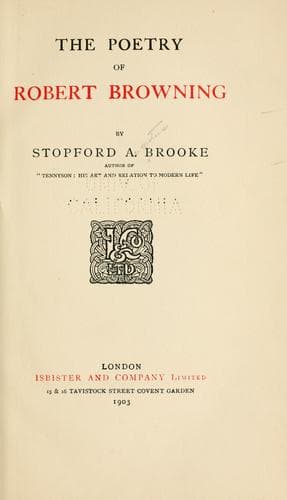
The poetry of Robert BrowningBrooke, Stopford A. (Stopford Augustus)
General
The poetry of Robert Browning
Brooke, Stopford A. (Stopford Augustus)
Browning, Robert, 1812-1889 -- Criticism and interpretation
These, all and every one,
The King judged, sitting in the sun.
LUIGI. That King should still judge sitting in the sun!
His councillors, on left and right,
Looked anxious up,--but no surprise
Disturbed the King's old smiling eyes
Where the very blue had turned to white.
'Tis said, a Python scared one day
The breathless city, till he came,
With forty tongue and eyes on flame,
Where the old King sat to judge alway;
But when he saw the sweepy hair
Girt with a crown of berries rare
Which the god will hardly give to wear
To the maiden who singeth, dancing bare
In the altar-smoke by the pine-torch lights,
At his wondrous forest rites,--
Seeing this, he did not dare
Approach the threshold in the sun,
Assault the old king smiling there.
Such grace had kings when the world begun!
Then there are two other romantic pieces, not ringing with this early
note, but having in them a wafting scent of the Provençal spirit. One is
the song sung by Pippa when she passes the room where Jules and Phene
are talking--the song of Kate, the Queen. The other is the cry Rudel,
the great troubadour, sent out of his heart to the Lady of Tripoli whom
he never saw, but loved. The subject is romantic, but that, I think, is
all the romance in it. It is not Rudel who speaks but Browning. It is
not the twelfth but the nineteenth century which has made all that
analysis and over-worked illustration.
There remain, on this matter, _Childe Roland_ and the _Flight of the
Duchess_. I believe that _Childe Roland_ emerged, all of a sudden and to
Browning's surprise, out of the pure imagination, like the Sea-born
Queen; that Browning did not conceive it beforehand; that he had no
intention in it, no reason for writing it, and no didactic or moral aim
in it. It was not even born of his will. Nor does he seem to be
acquainted with the old story on the subject which took a ballad form
in Northern England. The impulse to write it was suddenly awakened in
him by that line out of an old song the Fool quotes in _King Lear_.
There is another tag of a song in _Lear_ which stirs a host of images in
the imagination; and out of which some poet might create a romantic
lyric:
Still through the hawthorn blows the cold wind.
But it does not produce so concrete a set of images as _Childe Roland to
the Dark Tower came_. Browning has made that his own, and what he has
done is almost romantic. Almost romantic, I say, because the
peculiarities of Browning's personal genius appear too strongly in
_Childe Roland_ for pure romantic story, in which the idiosyncrasy of
the poet, the personal element of his fancy, are never dominant. The
scenery, the images, the conduct of the tales of romance, are, on
account of their long passage through the popular mind, impersonal.
Public-domain text, read in full here on John Shaqi.
Reviews
Reviews
No reviews yet
Be the first to share your thoughts on this work.
Elsewhere in the archive
Join the Discussion
Join the discussion
Sign in to leave a comment or review.
Sign InorCreate an account