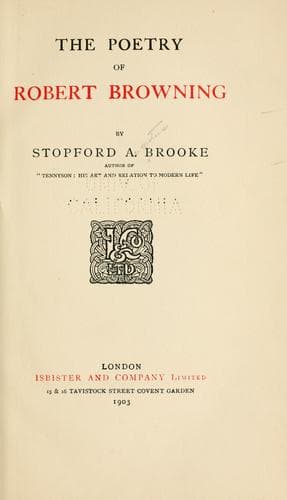
The poetry of Robert BrowningBrooke, Stopford A. (Stopford Augustus)
General
The poetry of Robert Browning
Brooke, Stopford A. (Stopford Augustus)
Browning, Robert, 1812-1889 -- Criticism and interpretation
The _Flight of the Duchess_ is full of the passion of escape from the
conventional; and no where is Browning more original or more the poet.
Its manner is exactly right, exactly fitted to the character and
condition of the narrator, who is the Duke's huntsman. Its metrical
movement is excellent, and the changes of that movement are in harmony
with the things and feelings described. It is astonishingly swift,
alive, and leaping; and it delays, as a stream, with great charm, when
the emotion of the subject is quiet, recollective, or deep. The
descriptions of Nature in the poem are some of the most vivid and true
in Browning's work. The sketches of animal life--so natural on the lips
of the teller of the story--are done from the keen observation of a
huntsman, and with his love for the animals he has fed, followed and
slain. And, through it all, there breathes the romantic passion--to be
out of the world of custom and commonplace, set free to wander for ever
to an unknown goal; to drink the air of adventure and change; not to
know to-day what will take place to-morrow, only to know that it will be
different; to ride on the top of the wave of life as it runs before the
wind; to live with those who live, and are of the same mind; to be loved
and to find love the best good in the world; to be the centre of hopes
and joys among those who may blame and give pain, but who are never
indifferent; to have many troubles, but always to pursue their far-off
good; to wring the life out of them, and, at the last, to have a new
life, joy and freedom in another and a fairer world. But let Browning
tell the end:
So, at the last shall come old age.
Decrepit as befits that stage;
How else would'st thou retire apart
With the hoarded memories of thy heart,
And gather all to the very least
Of the fragments of life's earlier feast,
Let fall through eagerness to find
The crowning dainties yet behind?
Ponder on the entire past
Laid together thus at last,
When the twilight helps to fuse
The first fresh with the faded hues.
And the outline of the whole
Grandly fronts for once thy soul.
And then as, 'mid the dark, a gleam
Of yet another morning breaks,
And, like the hand which ends a dream,
Death, with the might of his sunbeam,
Touches the flesh, and the soul awakes,
Then----
Then the romance of life sweeps into the world beyond. But even in that
world the duchess will never settle down to a fixed life. She will be,
like some of us, a child of the wandering tribes of eternity.
Public-domain text, read in full here on John Shaqi.
Reviews
Reviews
No reviews yet
Be the first to share your thoughts on this work.
Elsewhere in the archive
Join the Discussion
Join the discussion
Sign in to leave a comment or review.
Sign InorCreate an account