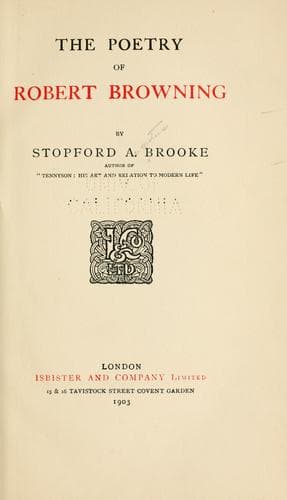
The poetry of Robert BrowningBrooke, Stopford A. (Stopford Augustus)
General
The poetry of Robert Browning
Brooke, Stopford A. (Stopford Augustus)
Browning, Robert, 1812-1889 -- Criticism and interpretation
This romantic passion which never dies even in our modern society, is
embodied in the gipsy crone who, in rags and scarcely clinging to life,
suddenly lifts into youth and queenliness, just as in a society, where
romance seems old or dead, it springs into fresh and lovely life. This
is the heart of the poem, and it is made to beat the more quickly by the
wretched attempt of the duke and his mother to bring back the
observances of the Middle Ages without their soul. Nor even then does
Browning leave his motive. The huntsman has heard the gipsy's song; he
has seen the light on his mistress' face as she rode away--the light
which is not from sun or star--and the love of the romantic world is
born in him. He will not leave his master; there his duty lies. "I must
see this fellow his sad life through." But then he will go over the
mountains, after his lady, leaving the graves of his wife and children,
into the unknown, to find her, or news of her, in the land of the
wanderers. And if he never find her, if, after pleasant journeying,
earth cannot give her to his eyes, he will still pursue his quest in a
world where romance and formality are not married together.
So I shall find out some snug corner,
Under a hedge, like Orson the wood-knight,
Turn myself round and bid the world Good Night;
And sleep a sound sleep till the trumpet's blowing
Wakes me (unless priests cheat us laymen)
To a world where will be no further throwing
Pearls before swine that can't value them. Amen.
* * * * *
CHAPTER XI
_IMAGINATIVE REPRESENTATIONS_
All poems might be called "imaginative representations." But the class
of poems in Browning's work to which I give that name stands apart. It
includes such poems as _Cleon, Caliban on Setebos, Fra Lippo Lippi_, the
_Epistle of Karshish_, and they isolate themselves, not only in
Browning's poetry, but in English poetry. They have some resemblance in
aim and method to the monologues of Tennyson, such as the _Northern
Farmer_ or _Rizpah_, but their aim is much wider than Tennyson's, and
their method far more elaborate and complex.
What do they represent? To answer this is to define within what limits I
give them the name of "imaginative representations." They are not only
separate studies of individual men as they breathed and spoke; face,
form, tricks of body recorded; intelligence, character, temper of mind,
spiritual aspiration made clear--Tennyson did that; they are also
studies of these individual men--Cleon, Karshish and the rest--as
general types, representative images, of the age in which they lived; or
of the school of art to which they belonged; or of the crisis in
theology, religion, art, or the social movement which took place while
the men they paint were alive, and which these men led, on formed, or
followed. That is their main element, and it defines them.
Public-domain text, read in full here on John Shaqi.
Reviews
Reviews
No reviews yet
Be the first to share your thoughts on this work.
Elsewhere in the archive
Join the Discussion
Join the discussion
Sign in to leave a comment or review.
Sign InorCreate an account