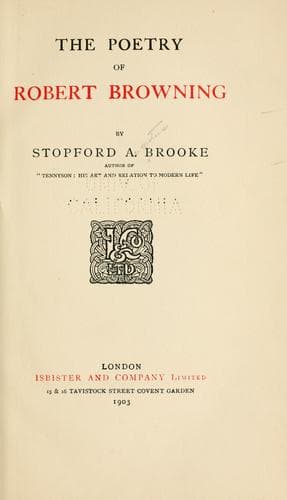
The poetry of Robert BrowningBrooke, Stopford A. (Stopford Augustus)
General
The poetry of Robert Browning
Brooke, Stopford A. (Stopford Augustus)
Browning, Robert, 1812-1889 -- Criticism and interpretation
But even without great knowledge such poems may be written, if the poet
have imagination, and the power to execute in metrical words what has
been imagined. _Theology in the Island_ and the prologue to a _Death in
the Desert_ are examples of this. Browning knew nothing of that island
in the undiscovered seas where Prosper dwelt, but he made all the
scenery of it and all its animal life, and he re-created Caliban. He had
never seen the cave in the desert where he placed John to die, nor the
sweep of rocky hills and sand around it, nor the Bactrian waiting with
the camels. Other poets, of course, have seen unknown lands and alien
folks, but he has seen them more vividly, more briefly, more forcibly.
His imagination was objective enough.
But it was as subjective as it was objective. He saw the soul of Fra
Lippo Lippi and the soul of his time as vividly as he saw the streets of
Florence at night, the watch, the laughing girls, and the palace of the
Medici round the corner. It was a remarkable combination, and it is by
this combination of the subjective and objective imagination that he
draws into some dim approach to Shakespeare; and nowhere closer than in
these poems.
Again, not only the main character of each of these poems, but all the
figures introduced (sometimes only in a single line) to fill up the
background, are sketched with as true and vigorous a pencil as the main
figure; are never out of place or harmony with the whole, and are justly
subordinated. The young men who stand round the Bishop's bed when he
orders his tomb, the watchmen in _Fra Lippo Lippi_, the group of St.
John's disciples, are as alive, and as much in tune with the whole, as
the servants and tenants of Justice Shallow. Again, it is not only the
lesser figures, but the scenery of these poems which is worth our study.
That also is closely fitted to the main subject. The imagination paints
it for that, and nothing else. It would not fit any other subject. For
imagination, working at white heat, cannot do what is out of harmony; no
more than a great musician can introduce a false chord. All goes
together in these poems--scenery, characters, time, place and action.
Public-domain text, read in full here on John Shaqi.
Reviews
Reviews
No reviews yet
Be the first to share your thoughts on this work.
Elsewhere in the archive
Join the Discussion
Join the discussion
Sign in to leave a comment or review.
Sign InorCreate an account