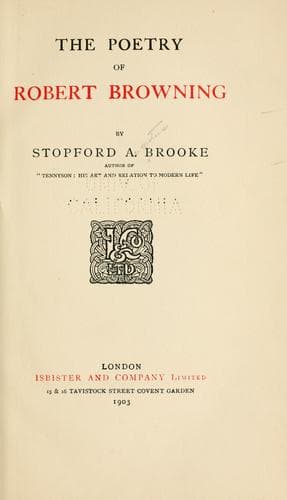
The poetry of Robert BrowningBrooke, Stopford A. (Stopford Augustus)
General
The poetry of Robert Browning
Brooke, Stopford A. (Stopford Augustus)
Browning, Robert, 1812-1889 -- Criticism and interpretation
They are not dramatic. Their action and ideas are confined to one
person, and their circumstance and scenery to one time and place. But
Browning, unlike Tennyson, filled the background of the stage on which
he placed his single figure with a multitude of objects, or animals, or
natural scenery, or figures standing round or in motion; and these give
additional vitality and interest to the representation. Again, they are
short, as short as a soliloquy or a letter or a conversation in a
street. Shortness belongs to this form of poetic work--a form to which
Browning gave a singular intensity. It follows that they must not be
argumentative beyond what is fitting. Nor ought they to glide into the
support of a thesis, or into didactic addresses, as _Bishop Blougram_
and _Mr. Sludge_ do. These might be called treatises, and are apart from
the kind of poem of which I speak. They begin, indeed, within its
limits, but they soon transgress those limits; and are more properly
classed with poems which, also representative, have not the brevity, the
scenery, the lucidity, the objective representation, the concentration
of the age into one man's mind, which mark out these poems from the
rest, and isolate them into a class of their own.
The voice we hear in them is rarely the voice of Browning; nor is the
mind of their personages his mind, save so far as he is their creator.
There are a few exceptions to this, but, on the whole, Browning has, in
writing these poems, stripped himself of his own personality. He had, by
creative power, made these men; cast them off from himself, and put them
into their own age. They talk their minds out in character with their
age. Browning seems to watch them, and to wonder how they got out of his
hands and became men. That is the impression they make, and it
predicates a singular power of imagination. Like the Prometheus of
Goethe, the poet sits apart, moulding men and then endowing them with
life. But he cannot tell, any more than Prometheus, what they will say
and do after he has made them. He does tell, of course, but that is not
our impression. Our impression is that they live and talk of their own
accord, so vitally at home they are in the country, the scenery, and the
thinking of the place and time in which he has imagined them.
Great knowledge seems required for this, and Browning had indeed an
extensive knowledge not so much of the historical facts, as of the
tendencies of thought which worked in the times wherein he placed his
men. But the chief knowledge he had, through his curious reading, was of
a multitude of small intimate details of the customs, clothing,
architecture, dress, popular talk and scenery of the towns and country
of Italy from the thirteenth century up to modern times. To every one of
these details--such as are found in _Sordello_, in _Fra Lippo Lippi_, in
the _Bishop orders his Tomb at St. Praxed's Church_--his vivid and
grasping imagination gave an uncommon reality.
Public-domain text, read in full here on John Shaqi.
Reviews
Reviews
No reviews yet
Be the first to share your thoughts on this work.
Elsewhere in the archive
Join the Discussion
Join the discussion
Sign in to leave a comment or review.
Sign InorCreate an account