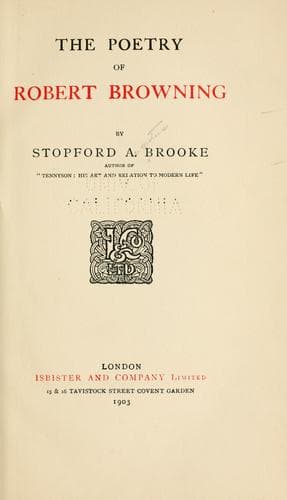
The poetry of Robert BrowningBrooke, Stopford A. (Stopford Augustus)
General
The poetry of Robert Browning
Brooke, Stopford A. (Stopford Augustus)
Browning, Robert, 1812-1889 -- Criticism and interpretation
The next of these "imaginative representations" is the poem called
_Cleon_. Cleon is a rich and famous artist of the Grecian isles, alive
while St. Paul was still making his missionary journeys, just at the
time when the Græco-Roman culture had attained a height of refinement,
but had lost originating power; when it thought it had mastered all the
means for a perfect life, but was, in reality, trembling in a deep
dissatisfaction on the edge of its first descent into exhaustion. Then,
as everything good had been done in the art of the past, cultivated men
began to ask "Was there anything worth doing?" "Was life itself worth
living?"; questions never asked by those who are living. Or "What is
life in its perfection, and when shall we have it?"; a question also not
asked by those who live in the morning of a new æra, when the world--as
in Elizabeth's days, as in 1789, as perhaps it may be in a few years--is
born afresh; but which is asked continually in the years when a great
movement of life has passed its culminating point and has begun to
decline. Again and again the world has heard these questions; in Cleon's
time, and when the Renaissance had spent its force, and at the end of
the reign of Louis XIV., and before Elizabeth's reign had closed, and
about 1820 in England, and of late years also in our society. This is
the temper and the time that Browning embodies in Cleon, who is the
incarnation of a culture which is already feeling that life is going out
of it.
Protus, the king, has written to him, and the poem is Cleon's answer to
the king. Browning takes care, as usual, to have his background of
scenery quite clear and fair. It is a courtyard to Cleon's house in one
of the sprinkled isles--
Lily on lily, that o'erlace the sea,
And laugh their pride when the light wave lisps "Greece."
I quote it; it marks the man and the age of luxurious culture.
They give thy letter to me, even now;
I read and seem as if I heard thee speak.
The master of thy galley still unlades
Gift after gift; they block my court at last
And pile themselves along its portico
Royal with sunset, like a thought of thee;
And one white she-slave from the group dispersed
Of black and white slaves (like the chequer work
Pavement, at once my nation's work and gift,
Now covered with this settle-down of doves),
One lyric woman, in her crocus vest
Woven of sea-wools, with her two white hands
Commends to me the strainer and the cup
Thy lip hath bettered ere it blesses mine.
But he is more than luxurious. He desires the highest life, and he
praises the king because he has acknowledged by his gifts the joy that
Art gives to life; and most of all he praises him, because he too
aspires, building a mighty tower, not that men may look at it, but that
he may gaze from its height on the sun, and think what higher he may
attain. The tower is the symbol of the cry of the king's soul.
Public-domain text, read in full here on John Shaqi.
Reviews
Reviews
No reviews yet
Be the first to share your thoughts on this work.
Elsewhere in the archive
Join the Discussion
Join the discussion
Sign in to leave a comment or review.
Sign InorCreate an account