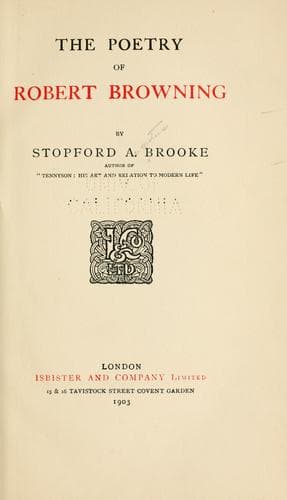
The poetry of Robert BrowningBrooke, Stopford A. (Stopford Augustus)
General
The poetry of Robert Browning
Brooke, Stopford A. (Stopford Augustus)
Browning, Robert, 1812-1889 -- Criticism and interpretation
Then he answers the king's letter. "It is true, O king, I am poet,
sculptor, painter, architect, philosopher, musician; all arts are mine.
Have I done as well as the great men of old? No, but I have combined
their excellences into one man, into myself.
"I have not chanted verse like Homer, no--
Nor swept string like Terpander--no--nor carved
And painted men like Phidias and his friend:
I am not great as they are, point by point.
But I have entered into sympathy
With these four, running these into one soul,
Who, separate, ignored each other's art.
Say, is it nothing that I know them all?
"This, since the best in each art has already been done, was the only
progress possible, and I have made it. It is not unworthy, king!
"Well, now thou askest, if having done this, 'I have not attained the
very crown of life; if I cannot now comfortably and fearlessly meet
death?' 'I, Cleon, leave,' thou sayest, 'my life behind me in my poems,
my pictures; I am immortal in my work. What more can life desire?'"
It is the question so many are asking now, and it is the answer now
given. What better immortality than in one's work left behind to move in
men? What more than this can life desire? But Cleon does not agree with
that. "If thou, O king, with the light now in thee, hadst looked at
creation before man appeared, thou wouldst have said, 'All is perfect so
far.' But questioned if anything more perfect in joy might be, thou
wouldst have said, 'Yes; a being may be made, unlike these who do not
know the joy they have, who shall be conscious of himself, and know that
he is happy. Then his life will be satisfied with daily joy.'" O king,
thou wouldst have answered foolishly. The higher the soul climbs in joy
the more it sees of joy, and when it sees the most, it perishes. Vast
capabilities of joy open round it; it craves for all it presages; desire
for more deepening with every attainment. And then the body intervenes.
Age, sickness, decay, forbid attainment. Life is inadequate to joy. What
have the gods done? It cannot be their malice, no, nor carelessness;
but--to let us see oceans of joy, and only give us power to hold a
cupful--is that to live? It is misery, and the more of joy my artist
nature makes me capable of feeling, the deeper my misery.
"But then, O king, thou sayest 'that I leave behind me works that will
live; works, too, which paint the joy of life.' Yes, but to show what
the joy of life is, is not to have it. If I carve the young Phoebus, am
I therefore young? I can write odes of the delight of love, but grown
too grey to be beloved, can I have its delight? That fair slave of
yours, and the rower with the muscles all a ripple on his back who
lowers the sail in the bay, can write no love odes nor can they paint
the joy of love; but they can have it--not I."
Public-domain text, read in full here on John Shaqi.
Reviews
Reviews
No reviews yet
Be the first to share your thoughts on this work.
Elsewhere in the archive
Join the Discussion
Join the discussion
Sign in to leave a comment or review.
Sign InorCreate an account