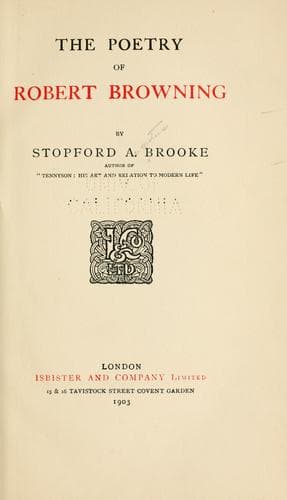
The poetry of Robert BrowningBrooke, Stopford A. (Stopford Augustus)
General
The poetry of Robert Browning
Brooke, Stopford A. (Stopford Augustus)
Browning, Robert, 1812-1889 -- Criticism and interpretation
But for those who are not Cleon and Protus, not kings in comfort or
poets in luxury, who have had no gladness, what end--what is to be said
of them? I will not stay to speak of _A Death in the Desert_, which is
another of these poems, because the most part of it is concerned with
questions of modern theology. St. John awakes into clear consciousness
just before his death in the cave where he lies tended by a few
disciples. He foresees some of the doubts of this century and meets them
as he can. The bulk of this poem, very interesting in its way, is
Browning's exposition of his own belief, not an imaginative
representation of what St. John actually would have said. It does not
therefore come into my subject. What does come into it is the
extraordinary naturalness and vitality of the description given by
John's disciple of the place where they were, and the fate of his
companions. This is invented in Browning's most excellent way. It could
not be better done.
The next poem is the _Epistle of Karshish, the Arab Physician_, to his
master, concerning his strange medical experience. The time is just
before the last siege of Jerusalem, and Karshish, journeying through
Jericho, and up the pass, stays for a few days at Bethany and meets
Lazarus. His case amazes him, and though he thinks his interest in it
unworthy of a man of science in comparison with the new herbs and new
diseases he has discovered, yet he is carried away by it and gives a
full account of it to his master.
I do not think that Browning ever wrote a poem the writing of which he
more enjoyed. The creation of Karshish suited his humour and his quaint
play with recondite knowledge. He describes the physician till we see
him alive and thinking, in body and soul. The creation of Lazarus is
even a higher example of the imaginative power of Browning; and that it
is shaped for us through the mind of Karshish, and in tune with it,
makes the imaginative effort the more remarkable. Then the problem--how
to express the condition of a man's body and soul, who, having for three
days according to the story as Browning conceives it lived consciously
in the eternal and perfect world, has come back to dwell in this
world--was so difficult and so involved in metaphysical strangenesses,
that it delighted him.
Of course, he carefully prepares his scenery to give a true semblance to
the whole. Karshish comes up the flinty pass from Jericho; he is
attacked by thieves twice and beaten, and the wild beasts endanger his
path;
A black lynx snarled and pricked a tufted ear,
Lust of my blood inflamed his yellow balls;
I cried and threw my staff and he was gone,
and then, at the end of the pass, he met Lazarus. See how vividly the
scenery is realised--
Public-domain text, read in full here on John Shaqi.
Reviews
Reviews
No reviews yet
Be the first to share your thoughts on this work.
Elsewhere in the archive
Join the Discussion
Join the discussion
Sign in to leave a comment or review.
Sign InorCreate an account