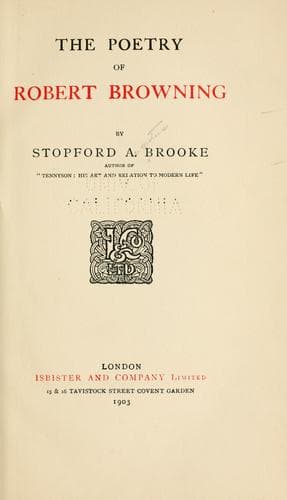
The poetry of Robert BrowningBrooke, Stopford A. (Stopford Augustus)
General
The poetry of Robert Browning
Brooke, Stopford A. (Stopford Augustus)
Browning, Robert, 1812-1889 -- Criticism and interpretation
The knowledge, he thinks, of what joy is, of all that life can give,
which increases in the artist as his feebleness increases, makes his
fate the deadlier. What is it to him that his works live? He does not
live. The hand of death grapples the throat of life at the moment when
he sees most clearly its infinite possibilities. Decay paralyses his
hand when he knows best how to use his tools. It is accomplished
wretchedness.
I quote his outburst. It is in the soul of thousands who have no hope of
a life to come.
"But," sayest thou--(and I marvel, I repeat,
To find thee trip on such a mere word) "what
Thou writest, paintest, stays; that does not die:
Sappho survives, because we sing her songs,
And Æschylus, because we read his plays!"
Why, if they live still, let them come and take
Thy slave in my despite, drink from thy cup,
Speak in my place! "Thou diest while I survive?"--
Say rather that my fate is deadlier still,
In this, that every day my sense of joy
Grows more acute, my soul (intensified
By power and insight) more enlarged, more keen;
While every day my hairs fall more and more,
My hand shakes, and the heavy years increase--
The horror quickening still from year to year,
The consummation coming past escape
When I shall know most, and yet least enjoy--
When all my works wherein I prove my worth,
Being present still to mock me in men's mouths,
Alive still, in the praise of such as thou,
I, I the feeling, thinking, acting man,
The man who loved his life so overmuch,
Sleep in my urn. It is so horrible
I dare at times imagine to my need
Some future state revealed to us by Zeus,
Unlimited in capability
For joy, as this is in desire of joy,
--To seek which the joy-hunger forces us:
That, stung by straitness of our life, made strait
On purpose to make prized the life at large--
Freed by the throbbing impulse we call death,
We burst there as the worm into the fly.
Who, while a worm still, wants his wings. But no!
Zeus has not yet revealed it; and alas,
He must have done so, were it possible!
This is one only of Browning's statements of what he held to be the
fierce necessity for another life. Without it, nothing is left for
humanity, having arrived at full culture, knowledge, at educated love of
beauty, at finished morality and unselfishness--nothing in the end but
Cleon's cry--sorrowful, somewhat stern, yet gentle--to Protus,
Live long and happy, and in that thought die,
Glad for what was. Farewell.
Public-domain text, read in full here on John Shaqi.
Reviews
Reviews
No reviews yet
Be the first to share your thoughts on this work.
Elsewhere in the archive
Join the Discussion
Join the discussion
Sign in to leave a comment or review.
Sign InorCreate an account