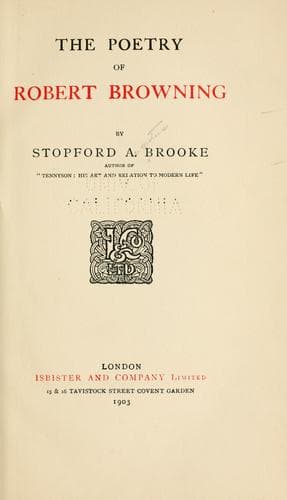
The poetry of Robert BrowningBrooke, Stopford A. (Stopford Augustus)
General
The poetry of Robert Browning
Brooke, Stopford A. (Stopford Augustus)
Browning, Robert, 1812-1889 -- Criticism and interpretation
We have seen with what force in _Sordello_ he realised the life and
tumult of the thirteenth century. The fourteenth century does not seem
to have attracted him much, though he frequently refers to its work in
Florence; but when the Renaissance in the fifteenth century took its
turn with decision towards a more open freedom of life and thought,
abandoning one after another the conventions of the past; when the moral
limits, which the Church still faintly insisted on, were more and more
withdrawn and finally blotted out; when, as the century passed into the
next, the Church led the revolt against decency, order, and morality;
when scepticism took the place of faith, even of duty, and criticism the
place of authority, then Browning became interested, not of course in
the want of faith and in immorality, but in the swift variety and
intensity of the movement of intellectual and social life, and in the
interlacing changes of the movement. This was an enchanting world for
him, and as he was naturally most interested in the arts, he represented
the way in which the main elements of the Renaissance appeared to him in
poems which were concerned with music, poetry, painting and the rest of
the arts, but chiefly with painting. Of course, when the Renaissance
began to die down into senile pride and decay, Browning, who never
ceased to choose and claim companionship with vigorous life, who
abhorred decay either in Nature or nations, in societies or in cliques
of culture, who would have preferred a blood-red pirate to the daintiest
of decadents--did not care for it, and in only one poem, touched with
contemptuous pity and humour, represented its disease and its
disintegrating elements, with so much power, however, with such grasping
mastery, that it is like a painting by Velasquez. Ruskin said justly
that the _Bishop orders his Tomb at St. Praxed's Church_ concentrated
into a few lines all the evil elements of the Renaissance. But this want
of care for the decaying Renaissance was contrasted by the extreme
pleasure with which he treated its early manhood in _Fra Lippo Lippi_.
Public-domain text, read in full here on John Shaqi.
Reviews
Reviews
No reviews yet
Be the first to share your thoughts on this work.
Elsewhere in the archive
Join the Discussion
Join the discussion
Sign in to leave a comment or review.
Sign InorCreate an account