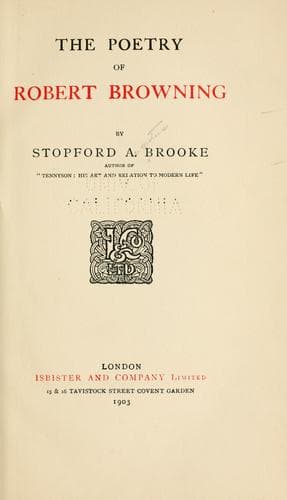
The poetry of Robert BrowningBrooke, Stopford A. (Stopford Augustus)
General
The poetry of Robert Browning
Brooke, Stopford A. (Stopford Augustus)
Browning, Robert, 1812-1889 -- Criticism and interpretation
The Renaissance had a life and seasons, like those of a human being. It
went through its childhood and youth like a boy of genius under the care
of parents from whose opinions and mode of life he is sure to sever
himself in the end; but who, having made a deep impression on his
nature, retain power over, and give direction to, his first efforts at
creation. The first art of the Renaissance, awakened by the discovery of
the classic remnants, retained a great deal of the faith and
superstition, the philosophy, theology, and childlike _naïveté_ of the
middle ages. Its painting and sculpture, but chiefly the first of these,
gave themselves chiefly to the representation of the soul upon the face,
and of the untutored and unconscious movements of the body under the
influence of religious passion; that is, such movements as expressed
devotion, fervent love of Christ, horror of sin, were chosen, and
harmonised with the expression of the face. Painting dedicated its work
to the representation of the heavenly life, either on earth in the story
of the gospels and in the lives of the saints, or in its glory in the
circles of heaven. Then, too, it represented the thought, philosophy,
and knowledge of its own time and of the past in symbolic series of
quiet figures, in symbolic pictures of the struggle of good with evil,
of the Church with the world, of the virtues with their opposites.
Naturally, then, the expression on the face of secular passions, the
movement of figures in war and trade and social life and the whole vast
field of human life in the ordinary world, were neglected as unworthy of
representation; and the free, full life of the body, its beauty, power
and charm, the objects which pleased its senses, the frank
representation of its movement under the influence of the natural as
contrasted with the spiritual passions, were looked upon with religious
dismay. Such, but less in sculpture than in painting, was the art of
the Renaissance in its childhood and youth, and Browning has scarcely
touched that time. He had no sympathy with a neglect of the body, a
contempt of the senses or of the beauty they perceived. He claimed the
physical as well as the intellectual and spiritual life of man as by
origin and of right divine. When, then, in harmony with a great change
in social and literary life, the art of the Renaissance began to turn,
in its early manhood, from the representation of the soul to the
representation of the body in natural movement and beauty; from the
representation of saints, angels and virtues to the representation of
actual men and women in the streets and rooms of Florence; from
symbolism to reality--Browning thought, "This suits me; this is what I
love; I will put this mighty change into a poem." And he wrote _Fra
Lippo Lippi_.
Public-domain text, read in full here on John Shaqi.
Reviews
Reviews
No reviews yet
Be the first to share your thoughts on this work.
Elsewhere in the archive
Join the Discussion
Join the discussion
Sign in to leave a comment or review.
Sign InorCreate an account