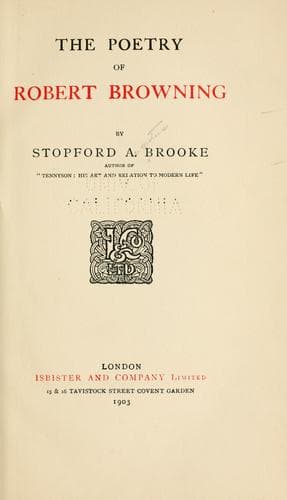
The poetry of Robert BrowningBrooke, Stopford A. (Stopford Augustus)
General
The poetry of Robert Browning
Brooke, Stopford A. (Stopford Augustus)
Browning, Robert, 1812-1889 -- Criticism and interpretation
So he sank back, saying the world was not worthy of his labours. "What?
Expose my noble work (things he had conceived but not done) to the prate
and pettiness of the common buyers who hang it on their walls! No, I
will rather paint the same monotonous round of Virgin, Child, and Saints
in the quiet church, in the sanctuary's gloom. No merchant then will
traffic in my heart. My pictures will moulder and die. Let them die. I
have not vulgarised myself or them." Brilliant and nobly wrought as the
first three poems are of which I have written, this quiet little piece
needed and received a finer workmanship, and was more difficult than
they.
Then there is _How it strikes a Contemporary_--the story of the gossip
of a Spanish town about a poor poet, who, because he wanders everywhere
about the streets observing all things, is mistaken for a spy of the
king. The long pages he writes are said to be letters to the king; the
misfortunes of this or that man are caused by his information. The
world thinks him a wonder of cleverness; he is but an inferior poet. It
imagines that he lives in Assyrian luxury; he lives and dies in a naked
garret. This imaginative representation might be of any time in a
provincial town of an ignorant country like Spain. It is a slight study
of what superstitious imagination and gossip will work up round any man
whose nature and manners, like those of a poet, isolate him from the
common herd. Force is added to this study by its scenery. The Moorish
windows, the shops, the gorgeous magistrates pacing down the promenade,
are touched in with a flying pencil; and then, moving through the crowd,
the lean, black-coated figure, with his cane and dog and his peaked hat,
clear flint eyes and beaked nose, is seen, as if alive, in the vivid
sunshine of Valladolid. But what Browning wished most to describe in
this poem was one of the first marks of a poet, even of a poor one like
this gentleman--the power of seeing and observing everything. Nothing
was too small, nothing uninteresting in this man's eyes. His very hat
was scrutinising.
He stood and watched the cobbler at his trade,
The man who slices lemons into drink,
The coffee-roaster's brazier, and the boys
That volunteer to help him turn its winch.
He glanced o'er books on stalls with half an eye,
And fly-leaf ballads on the vendor's string,
And broad-edged bold-print posters by the wall.
He took such cognisance of man and things,
If any beat a horse you felt he saw;
If any cursed a woman, he took note;
Yet stared at nobody, you stared at him,
And found, less to your pleasure than surprise,
He seemed to know you and expect as much.
Public-domain text, read in full here on John Shaqi.
Reviews
Reviews
No reviews yet
Be the first to share your thoughts on this work.
Elsewhere in the archive
Join the Discussion
Join the discussion
Sign in to leave a comment or review.
Sign InorCreate an account