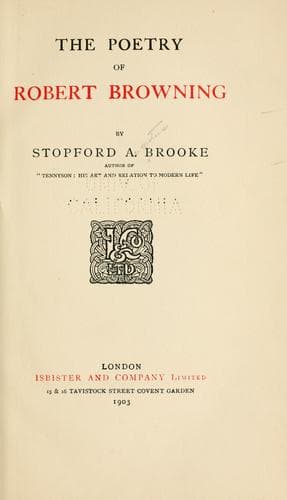
The poetry of Robert BrowningBrooke, Stopford A. (Stopford Augustus)
General
The poetry of Robert Browning
Brooke, Stopford A. (Stopford Augustus)
Browning, Robert, 1812-1889 -- Criticism and interpretation
That is the artist's way. It was Browning's way. He is describing
himself. In that fashion he roamed through Venice or Florence, stopping
every moment, attracted by the smallest thing, finding a poem in
everything, lost in himself yet seeing all that surrounded him, isolated
in thinking, different from and yet like the rest of the world.
Another poem--_My Last Duchess_--must be mentioned. It is plainly placed
in the midst of the period of the Renaissance by the word _Ferrara_,
which is added to its title. But it is rather a picture of two
temperaments which may exist in any cultivated society, and at any
modern time. There are numbers of such men as the Duke and such women as
the Duchess in our midst. Both are, however, drawn with mastery.
Browning has rarely done his work with more insight, with greater
keenness of portraiture, with happier brevity and selection. As in _The
Flight of the Duchess_, untoward fate has bound together two
temperaments sure to clash with each other--and no gipsy comes to
deliver the woman in this case. The man's nature kills her. It happens
every day. The Renaissance society may have built up more men of this
type than ours, but they are not peculiar to it.
Germany, not Italy, is, I think, the country in which Browning intended
to place two other poems which belong to the time of the
Renaissance--_Johannes Agricola in Meditation_ and _A Grammarian's
Funeral_. Their note is as different from that of the Italian poems as
the national temper of Germany is from that of Italy. They have no sense
of beauty for beauty's sake alone. Their atmosphere is not soft or gay
but somewhat stern. The logical arrangement of them is less one of
feeling than of thought. There is a stronger manhood in them, a grimmer
view of life. The sense of duty to God and Man, but little represented
in the Italian poems of the Renaissance, does exist in these two German
poems. Moreover, there is in them a full representation of aspiration to
the world beyond. But the Italian Renaissance lived for the earth alone,
and its loveliness; too close to earth to care for heaven.
It pleased Browning to throw himself fully into the soul of Johannes
Agricola; and he does it with so much personal fervour that it seems as
if, in one of his incarnations, he had been the man, and, for the moment
of his writing, was dominated by him. The mystic-passion fills the
poetry with keen and dazzling light, and it is worth while, from this
point of view, to compare the poem with Tennyson's _Sir Galahad_, and on
another side, with _St. Simeon Stylites_.
Public-domain text, read in full here on John Shaqi.
Reviews
Reviews
No reviews yet
Be the first to share your thoughts on this work.
Elsewhere in the archive
Join the Discussion
Join the discussion
Sign in to leave a comment or review.
Sign InorCreate an account