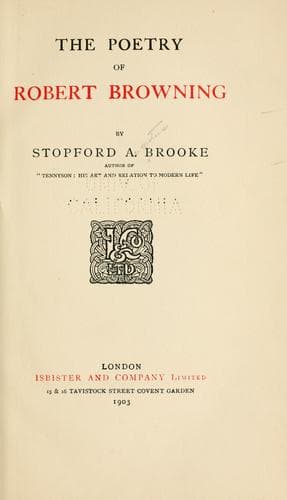
The poetry of Robert BrowningBrooke, Stopford A. (Stopford Augustus)
General
The poetry of Robert Browning
Brooke, Stopford A. (Stopford Augustus)
Browning, Robert, 1812-1889 -- Criticism and interpretation
The first woman we meet in Browning's poetry is Pauline; a twofold
person, exceedingly unlike the woman usually made by a young poet. She
is not only the Pauline idealised and also materialised by the selfish
passion of her lover, but also the real woman whom Browning has
conceived underneath the lover's image of her. This doubling of his
personages, as seen under two diverse aspects or by two different
onlookers, in the same poem, is not unfrequent in his poetry, and it
pleased his intellect to make these efforts. When the thing was well
done, its cleverness was amazing, even imaginative; when it was ill
done, it was confusing. Tennyson never did this; he had not analytic
power enough. What he sees of his personages is all one, quite clearly
drawn and easy to understand. But we miss in them, and especially in his
women, the intellectual play, versatility and variety of Browning.
Tennyson's women sometimes border on dulness, are without that movement,
change and surprises, which in women disturb mankind for evil or for
good. If Tennyson had had a little more of Browning's imaginative
analysis, and Browning a little less of it, both would have been better
artists.
The Pauline of the lover is the commonplace woman whom a young man so
often invents out of a woman for his use and pleasure. She is to be his
salvation, to sympathise with his ideals, joys and pains, to give him
everything, with herself, and to live for him and him alone. Nothing can
be more _naïf_ and simple than this common selfishness which forgets
that a woman has her own life, her own claim on the man, and her own
individuality to develop; and this element in the poem, which never
occurs again in Browning's poetry, may be the record of an early
experience. If so, he had escaped from this youthful error before he had
finished the poem, and despised it, perhaps too much. It is excusable
and natural in the young. His contempt for this kind of love is embodied
in the second Pauline. She is not the woman her lover imagines her to
be, but far older and more experienced than her lover; who has known
long ago what love was; who always liked to be loved, who therefore
suffers her lover to expatiate as wildly as he pleases; but whose life
is quite apart from him, enduring him with pleasurable patience,
criticising him, wondering how he can be so excited. There is a dim
perception in the lover's phrases of these elements in his mistress'
character; and that they are in her character is quite plain from the
patronising piece of criticism in French which Browning has put into her
mouth. The first touch of his humour appears in the contrast of the
gentle and lofty boredom of the letter with the torrents of love in the
poem. And if we may imagine that the lover is partly an image of what
Browning once felt in a youthful love, we may also think that the
making of the second and critical Pauline was his record, when his love
had passed, of what he thought about it all.
Public-domain text, read in full here on John Shaqi.
Reviews
Reviews
No reviews yet
Be the first to share your thoughts on this work.
Elsewhere in the archive
Join the Discussion
Join the discussion
Sign in to leave a comment or review.
Sign InorCreate an account