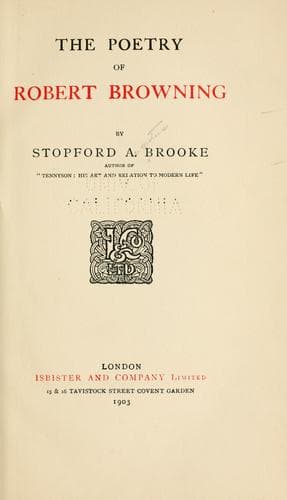
The poetry of Robert BrowningBrooke, Stopford A. (Stopford Augustus)
General
The poetry of Robert Browning
Brooke, Stopford A. (Stopford Augustus)
Browning, Robert, 1812-1889 -- Criticism and interpretation
This mode of treatment, so much more analytic than imaginative, belongs
to Browning as an artist. He seems, while he wrote, as if half of him
sat apart from the personages he was making, contemplating them in his
observant fashion, discussing them coolly in his mind while the other
half of him wrote about them with emotion; placing them in different
situations and imagining what they would then do; inventing trials for
them and recombining, through these trials, the elements of their
characters; arguing about and around them, till he sometimes loses the
unity of their personality. This is a weakness in his work when he has
to create characters in a drama who may be said, like Shakespeare's, to
have, once he has created them, a life of their own independent of the
poet. His spinning of his own thoughts about their characters makes us
often realise, in his dramas, the individuality of Browning more than
the individuality of the characters. We follow him at this work with
keen intellectual pleasure, but we do not always follow him with a
passionate humanity.
On the contrary, this habit, which was one cause of his weakness as an
artist in the drama, increased his strength as an artist when he made
single pictures of men and women at isolated crises in their lives; or
when he pictured them as they seemed at the moment to one, two, or three
differently tempered persons--pictorial sketches and studies which we
may hang up in the chambers of the mind for meditation or discussion.
Their intellectual power and the emotional interest they awaken, the
vivid imaginative lightning which illuminates them in flashes, arise out
of that part of his nature which made him a weak dramatist.
Had he chosen, for example, to paint Lady Carlisle as he conceived her,
in an isolated portrait, and in the same circumstances as in his drama
of _Strafford_, we should have had a clear and intimate picture of her
moving, alive at every point, amidst the decay and shipwreck of the
Court. But in the play she is a shade who comes and goes, unoutlined,
confused and confusing, scarcely a woman at all. The only clear hints of
what Browning meant her to be are given in the _asides_ of Strafford.
Public-domain text, read in full here on John Shaqi.
Reviews
Reviews
No reviews yet
Be the first to share your thoughts on this work.
Elsewhere in the archive
Join the Discussion
Join the discussion
Sign in to leave a comment or review.
Sign InorCreate an account