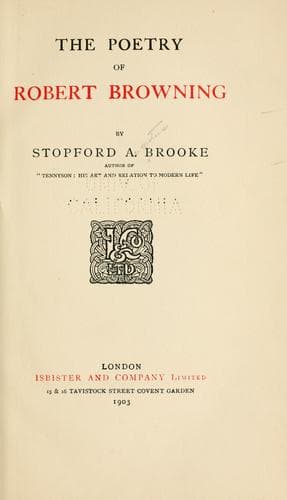
The poetry of Robert BrowningBrooke, Stopford A. (Stopford Augustus)
General
The poetry of Robert Browning
Brooke, Stopford A. (Stopford Augustus)
Browning, Robert, 1812-1889 -- Criticism and interpretation
By exercise of his powers Browning's genius had swiftly developed. There
comes a time, sooner or later, to a great poet when, after many
experiments, the doors of his intellect and soul fly open, and his
genius is flooded with the action and thought of what seems a universe.
And with this revelation of Man and Nature, a tidal wave of creative
power, new and impelling, carries the poet far beyond the station where
last he rested. It came to Browning now. The creation of Palma would be
enough to prove it, but there is not a character or scene in _Sordello_
which does not also prove it.
* * * * *
In this new outrush of his genius he created a very different woman from
Palma. He created Pippa, the Asolan girl, at the other end of society
from Palma, at the other end of feminine character. Owing to the host of
new thoughts which in this early summer of genius came pouring into his
soul--all of which he tried to express, rejecting none, choosing none
out of the rest, expressing only half of a great number of them; so
delighted with them all that he could leave none out--he became obscure
in _Sordello_. Owing also to the great complexity of the historical
_mise-en-scène_ in which he placed his characters in that poem, he also
became obscure. Had he been an experienced artist he would have left out
at least a third of the thoughts and scenes he inserted. As it was, he
threw all his thoughts and all the matters he had learnt about the
politics, cities, architecture, customs, war, gardens, religion and
poetry of North Italy in the thirteenth century, pell-mell into this
poem, and left them, as it were, to find their own places. This was very
characteristic of a young man when the pot of his genius was boiling
over. Nothing bolder, more incalculable, was ever done by a poet in the
period of his storm and stress. The boundless and to express it, was
never sought with more audacity. It was impossible, in this effort, for
him to be clear, and we need not be vexed with him. The daring, the
rush, the unconsciousness and the youth of it all, are his excuse, but
not his praise. And when the public comes to understand that the
dimness and complexity of _Sordello_ arise from plenteousness not
scarcity of thought, and that they were not a pose of the poet's but the
natural leaping of a full fountain just let loose from its mountain
chamber, it will have a personal liking, not perhaps for the poem but
for Browning. "I will not read the book," it will say, "but I am glad he
had it in him."
Public-domain text, read in full here on John Shaqi.
Reviews
Reviews
No reviews yet
Be the first to share your thoughts on this work.
Elsewhere in the archive
Join the Discussion
Join the discussion
Sign in to leave a comment or review.
Sign InorCreate an account