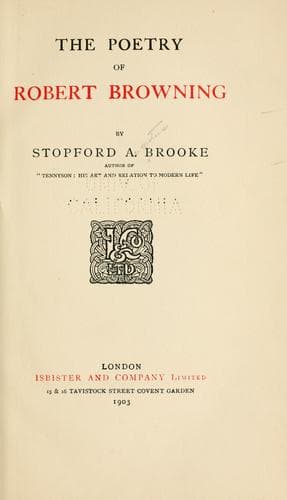
The poetry of Robert BrowningBrooke, Stopford A. (Stopford Augustus)
General
The poetry of Robert Browning
Brooke, Stopford A. (Stopford Augustus)
Browning, Robert, 1812-1889 -- Criticism and interpretation
Still it was an artistic failure, and when Browning understood that the
public could not comprehend him--and we must remember that he desired to
be comprehended, for he loved mankind--he thought he would use his
powers in a simpler fashion, and please the honest folk. So, in the joy
of having got rid in _Sordello_ of so many of his thoughts by expression
and of mastering the rest; and determined, since he had been found
difficult, to be the very opposite--loving contrast like a poet--he
wrote _Pippa Passes_. I need not describe its plan. Our business is with
the women in it.
Ottima, alive with carnal passion, in the fire of which the murder of
her husband seems a mere incident, is an audacious sketch, done in
splashes of ungradated colour. Had Browning been more in the woman's
body and soul he would not have done her in jerks as he has done. Her
trick of talking of the landscape, as if she were on a holiday like
Pippa, is not as subtly conceived or executed as it should be, and is
too far away from her dominant carnality to be natural. And her
sensualism is too coarse for her position. A certain success is
attained, but the imagination is frequently jarred. The very outburst of
unsensual love at the end, when her love passes from the flesh into the
spirit, when self-sacrifice dawns upon her and she begins to suffer the
first agonies of redemption, is plainly more due to the poet's pity than
to the woman's spirit. Again, Sebald is the first to feel remorse after
the murder. Ottima only begins to feel it when she thinks her lover is
ceasing to love her. I am not sure that to reverse the whole situation
would not be nearer to the truth of things; but that is matter of
discussion. Then the subject-matter is sordid. Nothing relieves the
coarseness of Sebald, Ottima and Luca and their relations to one another
but the few descriptions of nature and the happy flash of innocence when
Pippa passes by. Nor are there any large fates behind the tale or large
effects to follow which might lift the crime into dignity. This mean,
commonplace, ugly kind of subject had a strange attraction for Browning,
as we see in _The Inn Album_, in _Red Cotton Nightcap Country_, and
elsewhere. I may add that it is curious to find him, in 1841, writing
exactly like a modern realist, nearly fifty years before realism of this
kind had begun. And this illustrates what I have said of the way in
which he anticipated by so many years the kind of work to which the
literary world should come. The whole scene between Sebald and Ottima
might have been written by a powerful, relentless modern novelist.
Public-domain text, read in full here on John Shaqi.
Reviews
Reviews
No reviews yet
Be the first to share your thoughts on this work.
Elsewhere in the archive
Join the Discussion
Join the discussion
Sign in to leave a comment or review.
Sign InorCreate an account