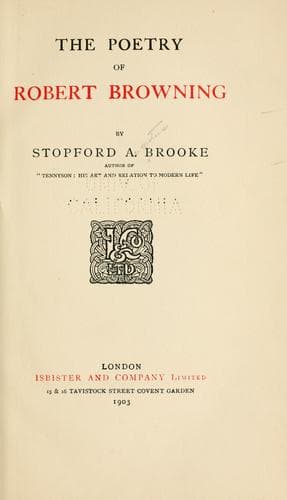
The poetry of Robert BrowningBrooke, Stopford A. (Stopford Augustus)
General
The poetry of Robert Browning
Brooke, Stopford A. (Stopford Augustus)
Browning, Robert, 1812-1889 -- Criticism and interpretation
We have more of this realism, but done with great skill, humanity, even
tenderness, in the meeting and talk of the young harlotry on the steps
of the Duomo near the fountain. When we think of this piece of bold,
clear, impressionist reality cast into the midst of the proprieties of
literature in 1841, it is impossible not to wonder and smile. The girls
are excellently drawn and varied from each other. Browning's pity
gathers round them, and something of underlying purity, of natural grace
of soul, of tenderness in memory of their youth emerges in them; and the
charm of their land is round their ways. There was also in his mind, I
think, a sense of picturesqueness in their class when they were young,
which, mingling with his pity for them, attracted his imagination, or
touched into momentary life that roving element in a poet which resents
the barriers made by social and domestic purity. _Fifine at the Fair_ is
partly a study of that temper which comes and goes, goes and comes in
the life not only of poets but of ordinary men and women.
Then, to illustrate this further, there is in _Sordello_ a brilliant
sketch of girls of this kind at Venice, full of sunlight, colour and
sparkling water, in which he has seen these butterflies of women as a
painter would see them, or as a poet who, not thinking then of moral
questions or feeling pity for their fate, is satisfied for the flying
moment with the picture they make, with the natural freedom of their
life.
But he does not leave that picture without a representation of the other
side of this class of womanhood. It was a daring thing, when he wished
to say that he would devote his whole work to the love and
representation of humanity to symbolise it by a sorrowful street-girl in
Venice who wistfully asks an alms; worn and broken with sorrow and
wrong; whose eyes appeal for pity, for comprehension of her good and for
his love; and whose fascination and beauty are more to him than those
of her unsuffering companions. The other side of that class of women is
here given with clear truth and just compassion, and the representation
is lifted into imaginative strength, range and dignity of thought and
feeling by her being made the image of the whole of humanity. "This
woman," he thought, "is humanity, whom I love, who asks the poet in me
to reveal her as she is, a divine seed of God to find some day its
flowering--the broken harlot of the universe, who will be, far off, the
Magdalen redeemed by her ineradicable love. That, and with every power I
have, I will, as poet, love and represent."
Public-domain text, read in full here on John Shaqi.
Reviews
Reviews
No reviews yet
Be the first to share your thoughts on this work.
Elsewhere in the archive
Join the Discussion
Join the discussion
Sign in to leave a comment or review.
Sign InorCreate an account