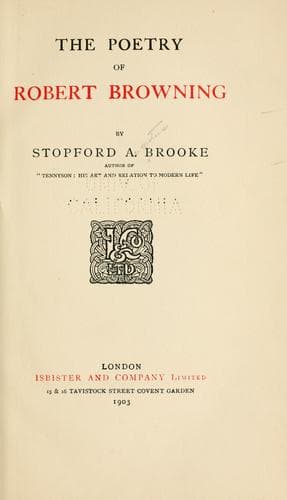
The poetry of Robert BrowningBrooke, Stopford A. (Stopford Augustus)
General
The poetry of Robert Browning
Brooke, Stopford A. (Stopford Augustus)
Browning, Robert, 1812-1889 -- Criticism and interpretation
Contrasted with her, and the quality of her love contrasted also, is
Mildred, the innocent child girl who loves for love's sake, and
continues to be lost in her love. But Browning's presentation of her
innocence, her love, is spoiled by the over-remorse, shame and fear
under whose power he makes her so helpless. They are in the
circumstances so unnaturally great that they lower her innocence and
love, and the natural courage of innocence and love. These rise again to
their first level, but it is only the passion of her lover's death which
restores them. And when they recur, she is outside of girlhood. One
touch of the courage she shows in the last scene would have saved in the
previous scene herself, her lover, and her brother. The lie she lets her
brother infer when she allows him to think that the lover she has
confessed to is not the Earl, yet that she will marry the Earl, degrades
her altogether and justly in her brother's eyes, and is so terribly out
of tune with her character that I repeat I cannot understand how
Browning could invent that situation. It spoils the whole presentation
of the girl. It is not only out of her character, it is out of nature.
Indeed, in spite of the poetry, in spite of the pathetic beauty of the
last scene, Mildred and Tresham are always over-heightened,
over-strained beyond the concert-pitch of nature. But the drawing of the
woman's character suffers more from this than the man's, even though
Tresham, in the last scene, is half turned into a woman. Sex seems to
disappear in that scene.
A different person is Colombe, the Duchess in _Colombe's Birthday_. That
play, as I have said, gets on, but it gets on because Colombe moves
every one in the play by her own motion. From beginning to end of the
action she is the fire and the soul of it. Innocent, frank and brave,
simple and constant among a group of false and worldly courtiers, among
whom she moves like the white Truth, untouched as yet by love or by the
fates of her position, she is suddenly thrown into a whirlpool of
affairs and of love; and her simplicity, clearness of intelligence,
unconscious rightness of momentary feeling, which comes of her not
thinking about her feelings--that rare and precious element in
character--above all, her belief in love as the one worthy thing in the
world, bring her out of the whirlpool, unshipwrecked, unstained by a
single wave of ill-feeling or mean thinking, into a quiet harbour of
affection and of power. For she will influence Berthold all his life
long.
Public-domain text, read in full here on John Shaqi.
Reviews
Reviews
No reviews yet
Be the first to share your thoughts on this work.
Elsewhere in the archive
Join the Discussion
Join the discussion
Sign in to leave a comment or review.
Sign InorCreate an account