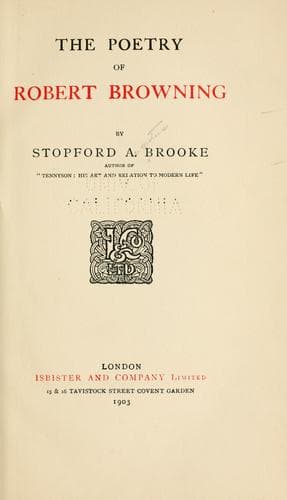
The poetry of Robert BrowningBrooke, Stopford A. (Stopford Augustus)
General
The poetry of Robert Browning
Brooke, Stopford A. (Stopford Augustus)
Browning, Robert, 1812-1889 -- Criticism and interpretation
I do not believe that Browning meant to make self-sacrifice the root of
Constance's doings. If he did, he has made a terrible mess of the whole
thing. He was much too clear-headed a moralist to link self-sacrifice to
systematic lying. Self-sacrifice is not self-sacrifice at all when it
sacrifices truth. It may wear the clothes of Love, but, in injuring
righteousness, it injures the essence of love. It has a surface beauty,
for it imitates love, but if mankind is allured by this beauty, mankind
is injured. It is the false Florimel of self-sacrifice. Browning, who
had studied self-sacrifice, did not exhibit it in Constance. There is
something else at the root of her actions, and I believe he meant it to
be jealousy. The very first lie she urges her lover to tell (that is, to
let the Queen imagine he loves her) is just the thing a jealous woman
would invent to try her lover and the Queen, if she suspected the Queen
of loving him, and him of being seduced from her by the worldly
advantage of marrying the Queen. And all the other lies are best
explained on the supposition of jealous experiments. At the last she is
satisfied; the crowning test had been tried. Through a sea of lying she
had made herself sure of Norbert's love, and she falls into his arms.
Had Browning meant Constance to be an image of self-sacrifice, he would
scarcely have written that line when Norbert, having told the truth of
the matter to the Queen, looks at both women, and cries out, "You two
glare, each at each, like panthers now." A woman, filled with the joy
and sadness of pure self-sacrifice, would not have felt at this moment
like a panther towards the woman for whom she had sacrificed herself.
Even as a study of jealousy, Constance is too subtle. Jealousy has none
of these labyrinthine methods; it goes straight with fiery passion to
its end. It may be said, then, that Constance is not a study of
jealousy. But it may be a study by Browning of what he thought in his
intellect jealousy would be. At any rate, Constance, as a study of
self-sacrifice, is a miserable failure. Moreover, it does not make much
matter whether she is a study of this or that, because she is eminently
wrong-natured. Her lying is unendurable, only to be explained or excused
by the madness of jealousy, and she, though jealous, is not maddened
enough by jealousy to excuse her lies. The situations she causes are
almost too ugly. Whenever the truth is told, either by the Queen or
Norbert, the situations break up in disgrace for her. It is difficult
to imagine how Norbert could go on loving her. His love would have
departed if they had come to live together. He is radically true, and
she is radically false. A fatal split would have been inevitable.
Nothing could be better for them both--after their momentary outburst of
love at the end--than death.
Public-domain text, read in full here on John Shaqi.
Reviews
Reviews
No reviews yet
Be the first to share your thoughts on this work.
Elsewhere in the archive
Join the Discussion
Join the discussion
Sign in to leave a comment or review.
Sign InorCreate an account