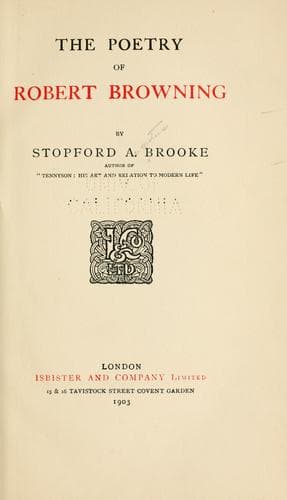
The poetry of Robert BrowningBrooke, Stopford A. (Stopford Augustus)
General
The poetry of Robert Browning
Brooke, Stopford A. (Stopford Augustus)
Browning, Robert, 1812-1889 -- Criticism and interpretation
What motherhood in its deep grief and joy, what sisterhood and wifehood
may be, have never been sung with more penetration and exquisiteness
than Wordsworth sang them. But of the immense range, beyond, of
womanhood he could not sing. Byron's women are mostly in love with Byron
under various names, and he rarely strays beyond the woman who is loved
or in love. The woman who is most vital, true and tender is Haidée in
_Don Juan_. Shelley's women melt into philosophic mist, or are used to
build up a political or social theory, as if they were "properties" of
literature. Cythna, Rosalind, Asia, Emilia are ideas, not realities.
Beatrice is alive, but she was drawn for him in the records of her
trial. Even the woman of his later lyrics soon ceases to be flesh and
blood. Keats let women alone, save in Isabella, and all that is of
womanhood in her is derived from Boccaccio. Madeline is nothing but a
picture. It is curious that his remarkable want of interest in the time
in which he lived should be combined with as great a want of interest in
women, as if the vivid life of any period in the history of a people
were bound up with the vivid life of women in that period. When women
awake no full emotion in a poet, the life of the time, as in the case of
Keats, awakes little emotion in him. He will fly to the past for his
subjects. Moreover, it is perhaps worth saying that when the poets cease
to write well about women, the phase of poetry they represent, however
beautiful it be, is beginning to decay. When poetry is born into a new
life, women are as living in it as men. Womanhood became at once one of
its dominant subjects in Tennyson and Browning. Among the new political,
social, religious, philosophic and artistic ideas which were then borne
like torches through England, the idea of the free development of women
was also born; and it carried with it a strong emotion. They claimed the
acknowledgment of their separate individuality, of their distinct use
and power in the progress of the world. This was embodied with
extraordinary fulness in _Aurora Leigh_, and its emotion drove itself
into the work of Tennyson and Browning. How Tennyson treated the subject
in the _Princess_ is well known. His representation of women in his
other poems does not pass beyond a few simple, well-known types both of
good and bad women. But the particular types into which the variety of
womanhood continually throws itself, the quick individualities, the
fantastic simplicities and subtleties, the resolute extremes, the
unconsidered impulses, the obstinate good and evil, the bold cruelties
and the bold self-sacrifices, the fears and audacities, the hidden work
of the thoughts and passions of women in the far-off worlds within them
where their soul claims and possesses its own desires--these were beyond
the power of Tennyson to describe, even, I think, to conceive. But they
were in the power of Browning, and he made them, at least in lyric
poetry, a chief part of his work.
Public-domain text, read in full here on John Shaqi.
Reviews
Reviews
No reviews yet
Be the first to share your thoughts on this work.
Elsewhere in the archive
Join the Discussion
Join the discussion
Sign in to leave a comment or review.
Sign InorCreate an account