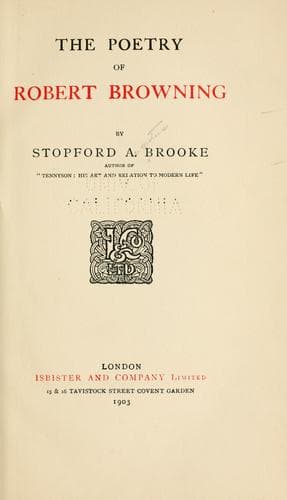
The poetry of Robert BrowningBrooke, Stopford A. (Stopford Augustus)
General
The poetry of Robert Browning
Brooke, Stopford A. (Stopford Augustus)
Browning, Robert, 1812-1889 -- Criticism and interpretation
In women he touched great variety and great individuality; two things
each of which includes the other, and both of which were dear to his
imagination. With his longing for variety of representation, he was not
content to pile womanhood up into a few classes, or to dwell on her
universal qualities. He took each woman separately, marking out the
points which differentiated her from, not those which she shared with,
the rest of her sex. He felt that if he dwelt only on the deep-seated
roots of the tree of womanhood, he would miss the endless play, fancy,
movement, interaction and variety of its branches, foliage and flowers.
Therefore, in his lyrical work, he leaves out for the most part the
simpler elements of womanhood and draws the complex, the particular, the
impulsive and the momentary. Each of his women is distinct from the
rest. That is a great comfort in a world which, through laziness, wishes
to busy itself with classes rather than with personalities. I do not
believe that Browning ever met man or woman without saying to
himself--Here is a new world; it may be classed, but it also stands
alone. What distinguishes it from the rest--that I will know and that
describe.
When women are not enslaved to conventions--and the new movement towards
their freedom of development which began shortly after 1840 had
enfranchised and has continued ever since to enfranchise a great number
from this slavery--they are more individual and various than men are
allowed to be. They carry their personal desires, aspirations and
impulses into act, speech, and into extremes with much greater licence
than is possible to men. One touches with them much more easily the
original stuff of humanity. It was this original, individual and various
Thing in women on which Browning seized with delight. He did not write
half as much as other poets had done of woman as being loved by man or
as loving him. I have said that the mere love-poem is no main element in
his work. He wrote of the original stuff of womanhood, of its good and
bad alike, sometimes of it as all good, as in Pompilia; but for the most
part as mingled of good and ill, and of the good as destined to conquer
the ill.
He did not exalt her above man. He thought her as vital, interesting and
important for progress as man, but not more interesting, vital, or
important. He neither lowered her nor idealised her beyond natural
humanity. She stands in his poetry side by side with man on an equality
of value to the present and future of mankind. And he has wrought this
out not by elaborate statement of it in a theory, as Tennyson did in
the _Princess_ with a conscious patronage of womanhood, but by
unconscious representation of it in the multitude of women whom he
invented.
Public-domain text, read in full here on John Shaqi.
Reviews
Reviews
No reviews yet
Be the first to share your thoughts on this work.
Elsewhere in the archive
Join the Discussion
Join the discussion
Sign in to leave a comment or review.
Sign InorCreate an account