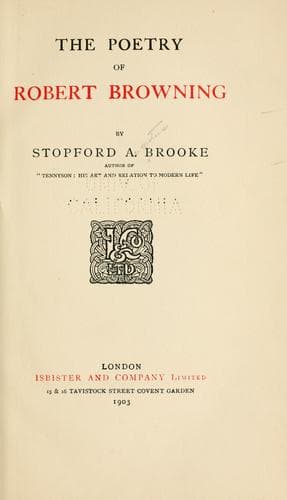
The poetry of Robert BrowningBrooke, Stopford A. (Stopford Augustus)
General
The poetry of Robert Browning
Brooke, Stopford A. (Stopford Augustus)
Browning, Robert, 1812-1889 -- Criticism and interpretation
For Stephanie sprained last night her wrist,
Ankle or something. "Pooh," cry you?
At any rate she danced, all say,
Vilely; her vogue has had its day.
Here comes my husband from his whist.
Here the woman speaks for herself. It is characteristic of Browning's
boldness that there are a whole set of poems in which he imagines the
unexpressed thoughts which a woman revolves in self-communion under the
questionings and troubles of the passions, and chiefly of the passion of
love. The most elaborate of these is _James Lee's Wife_, which tells
what she thinks of when after long years she has been unable to retain
her husband's love. Finally, she leaves him. The analysis of her
thinking is interesting, but the woman is not. She is not the quick,
natural woman Browning was able to paint so well when he chose. His own
analytic excitement, which increases in mere intellectuality as the poem
moves on, enters into her, and she thinks more through Browning the man
than through her womanhood. Women are complex enough, more complex than
men, but they are not complex in the fashion of this poem. Under the
circumstances Browning has made, her thought would have been quite clear
at its root, and indeed in its branches. She is represented as in love
with her husband. Were she really in love, she would not have been so
involved, or able to argue out her life so anxiously. Love or love's
sorrow knows itself at once and altogether, and its cause and aim are
simple. But Browning has unconsciously made the woman clear enough for
us to guess the real cause of her departure. That departure is believed
by some to be a self-sacrifice. There are folk who see self-sacrifice in
everything Browning wrote about women. Browning may have originally
intended her action to be one of self-sacrifice, but the thing, as he
went on, was taken out of his hands, and turns out to be quite a
different matter. The woman really leaves her husband because her love
for him was tired out. She talks of leaving her husband free, and
perhaps, in women's way, persuades herself that she is sacrificing
herself; but she desires in reality to set herself free from an
unavailing struggle to keep his love. There comes a time when the
striving for love wearies out love itself. And James Lee's wife had
reached that moment. Her departure, thus explained, is the most womanly
thing in the poem, and I should not wonder if Browning meant it so. He
knew what self-sacrifice really was, and this departure of the woman was
not a true self-sacrifice.
Public-domain text, read in full here on John Shaqi.
Reviews
Reviews
No reviews yet
Be the first to share your thoughts on this work.
Elsewhere in the archive
Join the Discussion
Join the discussion
Sign in to leave a comment or review.
Sign InorCreate an account