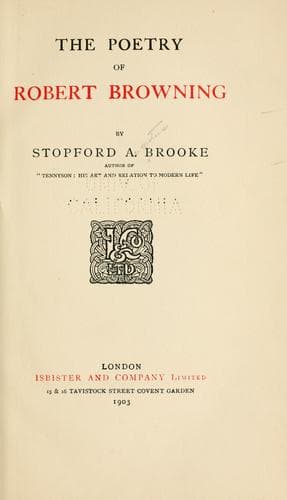
The poetry of Robert BrowningBrooke, Stopford A. (Stopford Augustus)
General
The poetry of Robert Browning
Brooke, Stopford A. (Stopford Augustus)
Browning, Robert, 1812-1889 -- Criticism and interpretation
Another of these poems in which a woman speaks out her heart is _Any
Wife to any Husband_. She is dying, and she would fain claim his undying
fidelity to his love of her; but though she believes in his love, she
thinks, when her presence is not with him, that his nature will be drawn
towards other women. Then what he brings her, when he meets her again,
will not be perfect. Womanly to the core, and her nature is a beautiful
nature, she says nothing which is not kind and true, and the picture she
draws of faithfulness, without one stain of wavering, is natural and
lovely. But, for all that, it is jealousy that speaks, the desire to
claim all for one's self. "Thou art mine, and mine only"--that fine
selfishness which injures love so deeply in the end, because it forbids
its expansion, that is, forbids the essential nature of love to act.
That may be pardoned, unless in its extremes, during life, if the pardon
does not increase it; but this is in the hour of death, and it is
unworthy of the higher world. To carry jealousy beyond the grave is a
phase of that selfish passion over which this hour, touched by the
larger thought of the infinite world, should have uplifted the woman.
Still, what she says is in nature, and Browning's imagination has closed
passionately round his subject. But he has left us with pity for the
woman rather than with admiration of her.
Perhaps the subtlest part of the poem is the impression left on us that
the woman knows all her pleading will be in vain, that she has fathomed
the weakness of her husband's character. He will not like to remember
that knowledge of hers; and her letting him feel it is a kind of
vengeance which will not help him to be faithful. It is also her worst
bitterness, but if her womanhood were perfect, she would not have had
that bitterness.
In these two poems, and in others, there is to be detected the
deep-seated and quiet half-contempt--contempt which does not damage
love, contempt which is half pity--which a woman who loves a man has for
his weakness under passion or weariness. Both the wives in these poems
feel that their husbands are inferior to themselves in strength of
character and of intellect. To feel this is common enough in women, but
is rarely confessed by them. A man scarcely ever finds it out from his
own observation; he is too vain for that. But Browning knew it. A poet
sees many things, and perhaps his wife told him this secret. It was like
his audacity to express it.
Public-domain text, read in full here on John Shaqi.
Reviews
Reviews
No reviews yet
Be the first to share your thoughts on this work.
Elsewhere in the archive
Join the Discussion
Join the discussion
Sign in to leave a comment or review.
Sign InorCreate an account