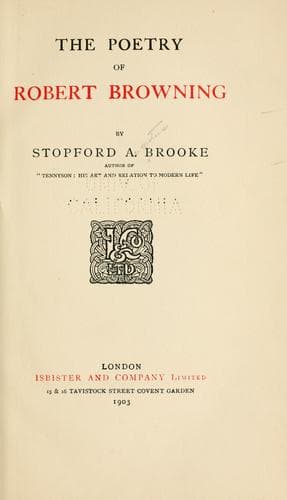
The poetry of Robert BrowningBrooke, Stopford A. (Stopford Augustus)
General
The poetry of Robert Browning
Brooke, Stopford A. (Stopford Augustus)
Browning, Robert, 1812-1889 -- Criticism and interpretation
So is my spirit, as flesh with sin,
Filled full, eaten out and in
With the face of her, the eyes of her,
The lips, the little chin, the stir
Of shadow round her mouth; and she
--I'll tell you--calmly would decree
That I should roast at a slow fire,
If that would compass her desire
And make her one whom they invite
To the famous ball to-morrow night
Contrasted with this woman, from whose brutal nature civilisation has
stripped away the honour and passion of the savage, the woman of _In a
Laboratory_ shines like a fallen angel. She at least is natural, and
though the passions she feels are the worst, yet she is capable of
feeling strongly. Neither have any conscience, but we can conceive that
one of these women might attain it, but the other not. Both are examples
of a thing I have said is exceedingly rare in Browning's poetry--men
or women left without some pity of his own touched into their
circumstances or character.
_In a Laboratory_ is a full-coloured sketch of what womanhood could
become in a court like that of Francis I.; in which every shred of
decency, gentlehood and honour had disappeared. Browning's description,
vivid as it is, is less than the reality. Had he deepened the colours of
iniquity and indecency instead of introducing so much detailed
description of the laboratory, detail which weakens a little our
impression of the woman, he had done better, but all the same there is
no poet in England, living or dead, who could have done it so well. One
of the best things in the poem is the impression made on us that it is
not jealousy, but the hatred of envy which is the motive of the woman.
Jealousy supposes love or the image of love, but among those who
surrounded Francis, love did not exist at all, only lust, luxury and
greed of power; and in the absence of love and in the scorn of it, hate
and envy reign unchallenged. This is what Browning has realised in this
poem, and, in this differentiation, he has given us not only historical
but moral truth.
Public-domain text, read in full here on John Shaqi.
Reviews
Reviews
No reviews yet
Be the first to share your thoughts on this work.
Elsewhere in the archive
Join the Discussion
Join the discussion
Sign in to leave a comment or review.
Sign InorCreate an account