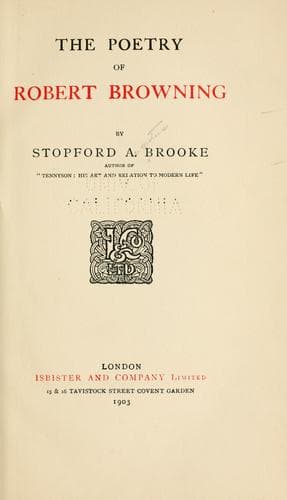
The poetry of Robert BrowningBrooke, Stopford A. (Stopford Augustus)
General
The poetry of Robert Browning
Brooke, Stopford A. (Stopford Augustus)
Browning, Robert, 1812-1889 -- Criticism and interpretation
Apart from these lighter and momentary poems about women there are
those written out of his own ideal of womanhood, built up not only from
all he knew and loved in his wife, but also out of the dreams of his
heart. They are the imaginings of the high honour and affection which a
man feels for noble, natural and honest womanhood. They are touched here
and there by complex thinking, but for the most part are of a beloved
simplicity and tenderness, and they will always be beautiful. There is
the sketch of the woman in _The Italian in England_, a never to be
forgotten thing. It is no wonder the exile remembered her till he died.
There is the image we form of the woman in _The Flowers Name_. He does
not describe her; she is far away, but her imagined character and
presence fill the garden with an incense sweeter than all the flowers,
and her beauty irradiates all beauty, so delicately and so plenteously
does the lover's passion make her visible. There is _Evelyn Hope_, and
surely no high and pure love ever created a more beautiful soul in a
woman than hers who waits her lover in the spiritual world. There are
those on whom we have already dwelt--Pippa, Colombe, Mildred, Guendolen.
There is the woman in the _Flight of the Duchess_; not a sketch, but a
completed picture. We see her, just emerged from her convent, thrilling
with eagerness to see the world, believing in its beauty, interested in
everything, in the movement of the leaves on the trees, of the birds in
the heaven, ready to speak to every one high or low, desirous to get at
the soul of all things in Nature and Humanity, herself almost a creature
of the element, akin to air and fire.
She is beaten into silence, but not crushed; overwhelmed by dry old
people, by imitation of dead things, but the life in her is not slain.
When the wandering gipsy claims her for a natural life, her whole nature
blossoms into beauty and joy. She will have troubles great and deep, but
every hour will make her conscious of more and more of life. And when
she dies, it will be the beginning of an intenser life.
Finally, there is his wife. She is painted in these lyric poems with a
simplicity of tenderness, with a reticence of worship as sacred as it is
fair and delicate, with so intense a mingling of the ideal and the real
that we never separate them, and with so much passion in remembrance of
the past and in longing for the future, that no comment can enhance the
picture Browning draws of her charm, her intellect and her spirit.
Public-domain text, read in full here on John Shaqi.
Reviews
Reviews
No reviews yet
Be the first to share your thoughts on this work.
Elsewhere in the archive
Join the Discussion
Join the discussion
Sign in to leave a comment or review.
Sign InorCreate an account