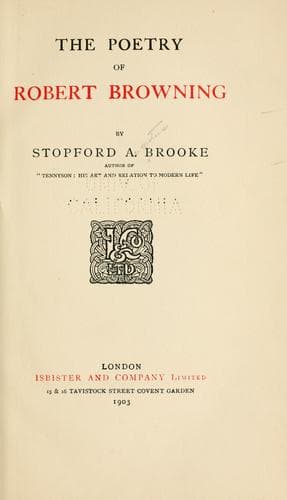
The poetry of Robert BrowningBrooke, Stopford A. (Stopford Augustus)
General
The poetry of Robert Browning
Brooke, Stopford A. (Stopford Augustus)
Browning, Robert, 1812-1889 -- Criticism and interpretation
These pictures of womanhood were set forth before 1868, when a collected
edition of his poems was published in six volumes. They were chiefly
short, even impressionist studies, save those in the dramas, and Palma
in _Sordello_. Those in the dramas were troubled by his want of power to
shape them in that vehicle. It would have then been a pity if, in his
matured strength, he had not drawn into clear existence, with full and
careful, not impressionist work, and with unity of conception, some
women who should, standing alone, become permanent personages in poetry;
whom men and women in the future, needing friends, should love, honour
and obey, and in whom, when help and sympathy and wisdom were wanted,
these healing powers should be found. Browning did this for us in
_Pompilia_ and _Balaustion_, an Italian and a Greek girl--not an English
girl. It is strange how to the very end he lived as a poet outside of
his own land.
In 1868, Pompilia appeared before the world, and she has captured ever
since the imagination, the conscience and the sentiment of all who love
womanhood and poetry. Her character has ennobled and healed mankind.
Born of a harlot, she is a star of purity; brought up by characters who
love her, but who do not rise above the ordinary meanness and small
commercial honesty of their class, she is always noble, generous,
careless of wealth, and of a high sense of honour. It is as if Browning
disdained for the time all the philosophy of heredity and environment;
and indeed it was characteristic of him to believe in the sudden
creation of beauty, purity and nobility out of their contraries and in
spite of them. The miracle of the unrelated birth of genius--that out of
the dunghill might spring the lily, and out of the stratum of crime the
saint--was an article of faith with him. Nature's or God's surprises
were dear to him; and nothing purer, tenderer, sweeter, more natural,
womanly and saintly was ever made than Pompilia, the daughter of a
vagrant impurity, the child of crime, the girl who grew to womanhood in
mean and vulgar circumstances.
The only hatred she earns is the hatred of Count Guido her husband, the
devil who has tortured and murdered her--the hatred of evil for good.
When Count Guido, condemned to death, bursts into the unrestrained
expression of his own nature, he cannot say one word about Pompilia
which is not set on fire by a hell of hatred. Nothing in Browning's
writing is more vivid, more intense, than these sudden outbursts of
tiger fierceness against his wife. They lift and enhance the image of
Pompilia.
Public-domain text, read in full here on John Shaqi.
Reviews
Reviews
No reviews yet
Be the first to share your thoughts on this work.
Elsewhere in the archive
Join the Discussion
Join the discussion
Sign in to leave a comment or review.
Sign InorCreate an account