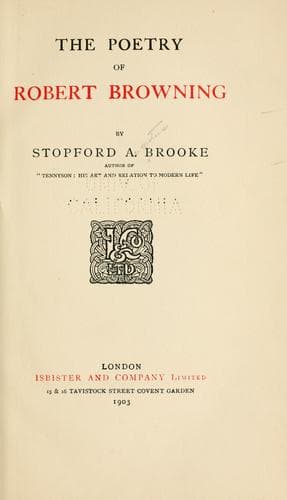
The poetry of Robert BrowningBrooke, Stopford A. (Stopford Augustus)
General
The poetry of Robert Browning
Brooke, Stopford A. (Stopford Augustus)
Browning, Robert, 1812-1889 -- Criticism and interpretation
Then, and this is subtly but not quite justly wrought into Euripides by
Balaustion, she traces through the play the slow awakening of the soul
of Admetos to the low-hearted thing he had done. He comes out of the
house, having disposed all things duteously and fittingly round the
dead, and Balaustion sees in his grave quietude that the truth is
dawning on him; when suddenly Pheres, his father, who had refused to die
for him, comes to lay his offering on the bier. This, Balaustion thinks,
plucks Admetos back out of unselfish thought into that lower atmosphere
in which he only sees his own advantage in the death of Alkestis; and in
which he now bitterly reproaches his father because he did not die to
save Alkestis. And the reproach is the more bitter because--and this
Balaustion, with her subtle morality, suggests--an undernote of
conscience causes him to see his own baser self, now prominent in his
acceptance of Alkestis' sacrifice, finished and hardened in the temper
of his father--young Admetos in old Pheres. He sees with dread and pain
what he may become when old. This hatred of himself in his father is,
Balaustion thinks, the source of his extreme violence with his father.
She, with the Greek sense of what was due to nature, seeks to excuse
this unfitting scene. Euripides has gone too far for her. She thinks
that, if Sophocles had to do with the matter, he would have made the
Chorus explain the man.
But the unnatural strife would not have been explained by Sophocles as
Balaustion explains it. That fine ethical twist of hers--"that Admetos
hates himself in his father," is too modern for a Greek. It has the
casuistical subtlety which the over-developed conscience of the
Christian Church encouraged. It is intellectual, too, rather than real,
metaphysical more than moral, Browning rather than Sophocles. Nor do I
believe that a Rhodian girl, even with all Athens at the back of her
brain, would have conceived it at all. Then Balaustion makes another
comment on the situation, in which there is more of Browning than of
herself. "Admetos," she says, "has been kept back by the noisy quarrel
from seeing into the truth of his own conduct, as he was on the point of
doing, for 'with the low strife comes the little mind.'" But when his
father is gone, and Alkestis is borne away, then, in the silence of the
house and the awful stillness in his own heart, he sees the truth. His
shame, the whole woe and horror of his failure in love, break, like a
toppling wave, upon him, and the drowned truth, so long hidden from him
by self, rose to the surface, and appalled him by its dead face. His
soul in seeing true, is saved, yet so las by fire. At this moment
Herakles comes in, leading Alkestis, redeemed from death; and finding,
so Balaustion thinks, her husband restored to his right mind.
Public-domain text, read in full here on John Shaqi.
Reviews
Reviews
No reviews yet
Be the first to share your thoughts on this work.
Elsewhere in the archive
Join the Discussion
Join the discussion
Sign in to leave a comment or review.
Sign InorCreate an account