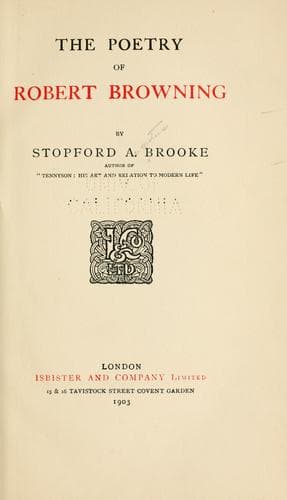
The poetry of Robert BrowningBrooke, Stopford A. (Stopford Augustus)
General
The poetry of Robert Browning
Brooke, Stopford A. (Stopford Augustus)
Browning, Robert, 1812-1889 -- Criticism and interpretation
Browning could write thus, out of his intellect alone. None of the
greater poets could. Their genius could not work without fusing into
their intellectual work intensity of feeling; and that combination
secured poetic treatment of their subject. It would have been totally
impossible for Milton, Shakespeare, Dante, Vergil, or even the great
mass of second-rate poets, to have written some of Browning's so-called
poetry--no matter how they tried. There was that in Browning's nature
which enabled him to exercise his intellectual powers alone, without
passion, and so far he almost ceases to deserve the name of poet. And
his pleasure in doing this grew upon him, and having done it with
dazzling power in part of _The Ring and the Book_, he was carried away
by it and produced a number of so-called poems; terrible examples of
what a poet can come to when he has allowed his pleasure in clever
analysis to tyrannise over him--_Prince Hohenstiel-Schwangau_, _The Inn
Album_, _Red Cotton Nightcap Country_, and a number of shorter poems in
the volumes which followed. In these, what Milton meant by passion,
simplicity and sensuousness were banished, and imagination existed only
as it exists in a prose writer.
This condition was slowly arrived at. It had not been fully reached when
he wrote _The Ring and the Book_. His poetic powers resisted their
enemies for many years, and had the better in the struggle. If it takes
a long time to cast a devil out, it takes a longer time to depose an
angel. And the devil may be utterly banished, but the angel never. And
though the devil of mere wit and the little devils of analytic
exercise--devils when they usurp the throne in a poet's soul and enslave
imaginative emotion--did get the better of Browning, it was only for a
time. Towards the end of his life he recovered, but never as completely
as he had once possessed them, the noble attributes of a poet. The evils
of the struggle clung to him; the poisonous pleasure he had pursued
still affected him; he was again and again attacked by the old malaria.
He was as a brand plucked from the burning.
Public-domain text, read in full here on John Shaqi.
Reviews
Reviews
No reviews yet
Be the first to share your thoughts on this work.
Elsewhere in the archive
Join the Discussion
Join the discussion
Sign in to leave a comment or review.
Sign InorCreate an account