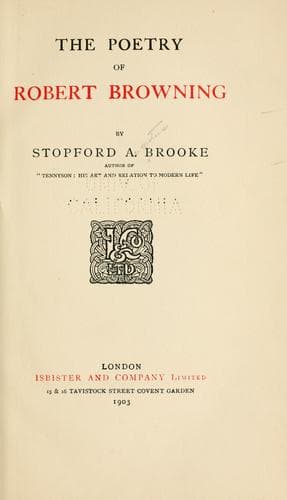
The poetry of Robert BrowningBrooke, Stopford A. (Stopford Augustus)
General
The poetry of Robert Browning
Brooke, Stopford A. (Stopford Augustus)
Browning, Robert, 1812-1889 -- Criticism and interpretation
_The Ring and the Book_ is the central point of this struggle. It is
full of emotion and thought concentrated on the subject, and commingled
by imagination to produce beauty. And whenever this is the case, as in
the books which treat of Caponsacchi and Pompilia, we are rejoiced by
poetry. In their lofty matter of thought and feeling, in their
simplicity and nobleness of spiritual beauty, poetry is dominant. In
them also his intellectual powers, and his imaginative and passionate
powers, are fused into one fire. Nor is the presentation of Guido
Franceschini under two faces less powerful, or that of the Pope, in his
meditative silence. But in these books the poetry is less, and is
mingled, as would naturally indeed be the case, with a searching
analysis, which intrudes too much into their imaginative work.
Over-dissection makes them cold. In fact, in fully a quarter of this
long poem, the analysing understanding, that bustling and self-conscious
person, who plays only on the surface of things and separates their
elements from one another instead of penetrating to their centre; who is
incapable of seeing the whole into which the various elements have
combined--is too masterful for the poetry. It is not, then, imaginative,
but intellectual pleasure which, as we read, we gain.
Then again there is throughout a great part of the poem a dangerous
indulgence of his wit; the amusement of remote analogies; the use of
far-fetched illustrations; quips and cranks and wanton wiles of the
reasoning fancy in deviating self-indulgence; and an allusiveness which
sets commentators into note-making effervescence. All these, and more,
which belong to wit, are often quite ungoverned, allowed to disport
themselves as they please. Such matters delight the unpoetic readers of
Browning, and indeed they are excellent entertainment. But let us call
them by their true name; let us not call them poetry, nor mistake their
art for the art of poetry. Writing them in blank verse does not make
them poetry. In _Half-Rome_, in _The Other Half-Rome_, and in _Tertium
Quid_, these elements of analysis and wit are exhibited in three-fourths
of the verse; but the other fourth--in description of scenes, in vivid
portraiture, in transient outbursts out of which passion, in glimpses,
breaks--rises into the realm of poetry. In the books which sketch the
lawyers and their pleadings, there is wit in its finest brilliancy,
analysis in its keenest veracity, but they are scarcely a poet's work.
The whole book is then a mixed book, extremely mixed. All that was
poetical in Browning's previous work is represented in it, and all the
unpoetical elements which had gradually been winning power in him, and
which showed themselves previously in _Bishop Blougram_ and _Mr.
Sludge_, are also there in full blast. It was, as I have said, the
central battlefield of two powers in him. And when _The Ring and the
Book_ was finished, the inferior power had for a time the victory.
Public-domain text, read in full here on John Shaqi.
Reviews
Reviews
No reviews yet
Be the first to share your thoughts on this work.
Elsewhere in the archive
Join the Discussion
Join the discussion
Sign in to leave a comment or review.
Sign InorCreate an account