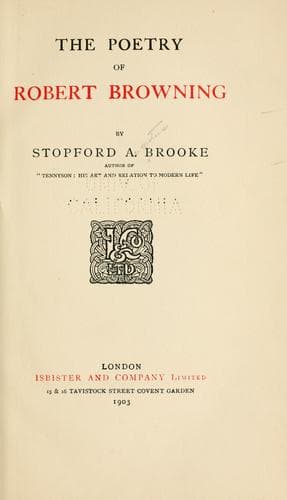
The poetry of Robert BrowningBrooke, Stopford A. (Stopford Augustus)
General
The poetry of Robert Browning
Brooke, Stopford A. (Stopford Augustus)
Browning, Robert, 1812-1889 -- Criticism and interpretation
We ought not to forget the date of the tale when we read the book. It is
just two hundred years ago. The murder of Pompilia took place in 1698;
and the book completes his studies of the Renaissance in its decay. If
_Sordello_ is worth our careful reading as a study of the thirteenth
century in North Italy, this book is as valuable as a record of the
society of its date. It is, in truth, a mine of gold; pure crude ore is
secreted from man's life, then moulded into figures of living men and
women by the insight and passion of the poet. In it is set down Rome as
she was--her customs, opinions, classes of society; her dress, houses,
streets, lanes, byeways and squares; her architecture, fountains,
statues, courts of law, convents, gardens; her fashion and its
drawing-rooms, the various professions and their habits, high life and
middle class, tradesmen and beggars, priest, friar, lay-ecclesiastic,
cardinal and Pope. Nowhere is this pictorial and individualising part of
Browning's genius more delighted with its work. Every description is
written by a lover of humanity, and with joy.
Nor is he less vivid in the _mise-en-scène_ in which he places this
multitude of personages. In _Half-Rome_ we mingle with the crowd between
Palazzo Fiano and Ruspoli, and pass into the church of Lorenzo in Lucina
where the murdered bodies are exposed. The mingled humours of the crowd,
the various persons and their characters are combined with and enhanced
by the scenery. Then there is the Market Place by the Capucin convent of
the Piazza Barberini, with the fountains leaping; then the _Réunion_ at
a palace, and the fine fashionable folk among the mirrors and the
chandeliers, each with their view of the question; then the Courthouse,
with all its paraphernalia, where Guido and Caponsacchi plead; then, the
sketches, as new matters turn up, of the obscure streets of Rome, of the
country round Arezzo, of Arezzo itself, of the post road from Arezzo to
Rome and the country inn near Rome, of the garden house in the suburbs,
of the households of the two advocates and their different ways of
living; of the Pope in his closet and of Guido in the prison cell; and
last, the full description of the streets and the Piazza del Popolo on
the day of the execution--all with a hundred vivifying, illuminating,
minute details attached to them by this keen-eyed, observant, questing
poet who remembered everything he saw, and was able to use each detail
where it was most wanted. Memories are good, but good usage of them is
the fine power. The _mise-en-scène_ is then excellent, and Browning was
always careful to make it right, fitting and enlivening. Nowhere is this
better done than in the Introduction where he finds the book on a stall
in the Square of San Lorenzo, and describes modern Florence in his walk
from the Square past the Strozzi, the Pillar and the Bridge to Casa
Guidi on the other side of the Arno opposite the little church of San
Felice.
Public-domain text, read in full here on John Shaqi.
Reviews
Reviews
No reviews yet
Be the first to share your thoughts on this work.
Elsewhere in the archive
Join the Discussion
Join the discussion
Sign in to leave a comment or review.
Sign InorCreate an account