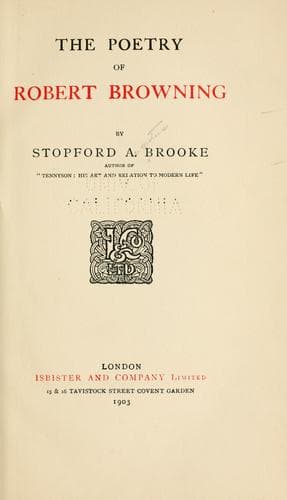
The poetry of Robert BrowningBrooke, Stopford A. (Stopford Augustus)
General
The poetry of Robert Browning
Brooke, Stopford A. (Stopford Augustus)
Browning, Robert, 1812-1889 -- Criticism and interpretation
To sum up then, there are books in the poem where matter of passion and
matter of thought are imaginatively wrought together. There are others
where psychological thought and metaphysical reasoning are dominant, but
where passionate feeling has also a high place. There are others where
analysis and wit far excel the elements of imaginative emotion; and
there are others where every kind of imagination is absent, save that
which is consistent throughout and which never fails--the power of
creating men and women into distinct individualities. That is left, but
it is a power which is not special to a poet. A prose writer may possess
it with the same fulness as a poet. Carlyle had it as remarkably as
Browning, or nearly as remarkably. He also had wit--a heavier wit than
Browning's, less lambent, less piercing, but as forcible.
One thing more may be said. The poem is far too long, and the subject
does not bear its length. The long poems of the world (I do not speak of
those by inferior poets) have a great subject, are concerned with
manifold fates of men, and are naturally full of various events and
varied scenery. They interest us with new things from book to book. In
_The Ring and the Book_ the subject is not great, the fates concerned
are not important, and the same event runs through twelve books and is
described twelve times. However we may admire the intellectual force
which actually makes the work interesting, and the passion which often
thrills us in it--this is more than the subject bears, and than we can
always endure. Each book is spun out far beyond what is necessary; a
great deal is inserted which would be wisely left out. No one could be
more concise than Browning when he pleased. His power of flashing a
situation or a thought into a few words is well known. But he did not
always use this power. And in _The Ring and the Book_, as in some of the
poems that followed it, he seems now and then to despise that power.
And now for the poem itself. Browning tells the story eight times by
different persons, each from a different point of view, and twice more
by the same person before and after his condemnation and, of course,
from two points of view. Then he practically tells it twice more in the
prologue and the epilogue--twelve times in all--and in spite of what I
have said about the too great length of the poem, this is an
intellectual victory that no one else but Browning could have won
against its difficulties. Whether it was worth the creation by himself
of the difficulty is another question. He chose to do it, and we had
better submit to him and get the good of his work. At least we may avoid
some of the weariness he himself feared by reading it in the way I have
mentioned, as Browning meant it to be read. Poems--being the highest
product of the highest genius of which man is capable--ought to be
approached with some reverence. And a part of that reverence is to read
them in accordance with the intention and desire of the writer.
Public-domain text, read in full here on John Shaqi.
Reviews
Reviews
No reviews yet
Be the first to share your thoughts on this work.
Elsewhere in the archive
Join the Discussion
Join the discussion
Sign in to leave a comment or review.
Sign InorCreate an account