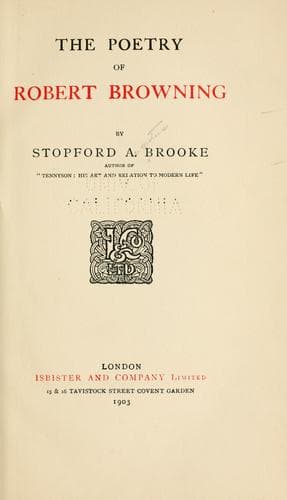
The poetry of Robert BrowningBrooke, Stopford A. (Stopford Augustus)
General
The poetry of Robert Browning
Brooke, Stopford A. (Stopford Augustus)
Browning, Robert, 1812-1889 -- Criticism and interpretation
Last of these main characters, the Pope appears. Guido, condemned to
death by the law, appeals from the law to the head of the Church,
because, being half an ecclesiastic, his death can only finally be
decreed by the ecclesiastical arm. An old, old man, with eyes clear of
the quarrels, conventions, class prejudices of the world, the Pope has
gone over all the case during the day, and now night has fallen. Far
from the noise of Rome, removed from the passions of the chief
characters, he is sitting in the stillness of his closet, set on his
decision. We see the whole case now, through his mind, in absolute
quiet. He has been on his terrace to look at the stars, and their solemn
peace is with him. He feels that he is now alone with God and his old
age. And being alone, he is not concise, but garrulous and discursive.
Browning makes him so on purpose. But discursive as his mind is, his
judgment is clear, his sentence determined. Only, before he speaks, he
will weigh all the characters, and face any doubts that may shoot into
his conscience. He passes Guido and the rest before his spiritual
tribunal, judging not from the legal point of view, but from that which
his Master would take at the Judgment Day. How have they lived; what
have they made of life? When circumstances invaded them with temptation,
how did they meet temptation? Did they declare by what they did that
they were on God's side or the devil's? And on these lines he delivers
his sentence on Pompilia, Caponsacchi, Guido, Pietro, Violante, and the
rest. He feels he speaks as the Vicegerent of God.
This solemn, silent, lonely, unworldly judgment of the whole case, done
in God's presence, is, after the noisy, crowded, worldly judgment of it
by Rome, after the rude humours of the law, and the terrible clashing of
human passions, most impressive; and it rises into the majesty of old
age in the summing up of the characters of Pompilia, Caponsacchi, and
Guido. I wish Browning had left it there. But he makes a sudden doubt
invade the Pope with a chill. Has he judged rightly in thinking that
divine truth is with him? Is there any divine truth on which he may
infallibly repose?
And then for many pages we are borne away into a theological discussion,
which I take leave to say is wearisome; and which, after all, lands the
Pope exactly at the point from which he set out--a conclusion at which,
as we could have told him beforehand, he would be certain to arrive. We
might have been spared this. It is an instance of Browning's pleasure in
intellectual discourse which had, as I have said, such sad results on
his imaginative work. However, at the end, the Pope resumes his interest
in human life. He determines; and quickly--"Let the murderer die
to-morrow."
Public-domain text, read in full here on John Shaqi.
Reviews
Reviews
No reviews yet
Be the first to share your thoughts on this work.
Elsewhere in the archive
Join the Discussion
Join the discussion
Sign in to leave a comment or review.
Sign InorCreate an account