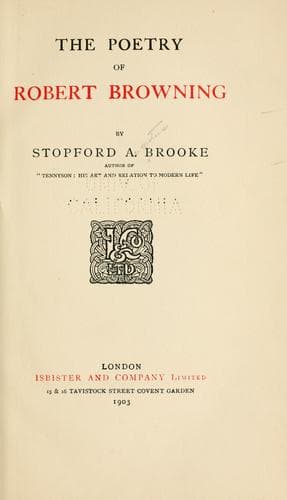
The poetry of Robert BrowningBrooke, Stopford A. (Stopford Augustus)
General
The poetry of Robert Browning
Brooke, Stopford A. (Stopford Augustus)
Browning, Robert, 1812-1889 -- Criticism and interpretation
Then comes the dreadful passion of Guido in the condemned cell, of
which I have spoken. And then, one would think the poem would have
closed. But no, the epilogue succeeds, in which, after all the tragedy,
humour reigns supreme. It brings us into touch with all that happened in
this case after the execution of Guido; the letters written by the
spectators, the lawyer's view of the deed, the gossip of Rome upon the
interesting occasion. No piece of humour in Browning's poetry, and no
portrait-sketching, is better than the letter written by a Venetian
gentleman in Rome giving an account of the execution. It is high comedy
when we are told that the Austrian Ambassador, who had pleaded for
Guido's life, was so vexed by the sharp "no" of the Pope (even when he
had told the Pope that he had probably dined at the same table with
Guido), that he very nearly refused to come to the execution, and would
scarcely vouchsafe it more than a glance when he did come--as if this
conduct of his were a slight which the Pope would feel acutely. Nor does
Browning's invention stop with this inimitable letter. He adds two other
letters which he found among the papers; and these give to the
characters of the two lawyers, new turns, new images of their steady
professional ambition not to find truth, but to gain the world.
One would think, after this, that invention would be weary. Not at all!
The Augustinian monk who attended Pompilia has not had attention enough;
and this is the place, Browning thinks, to show what he thought of the
case, and how he used it in his profession. So, we are given a great
part of the sermon he preached on the occasion, and the various
judgments of Rome upon it.
It is wonderful, after invention has been actively at work for eleven
long books, pouring forth its waters from an unfailing fountain, to find
it, at the end, as gay, as fresh, as keen, as youthful as ever. This, I
repeat, is the excellence of Browning's genius--fulness of creative
power, with imagination in it like a fire. It does not follow that all
it produces is poetry; and what it has produced in _The Ring and the
Book_ is sometimes, save for the metre, nothing better than prose. But
this is redeemed by the noble poetry of a great part of it. The book is,
as I have said, a mixed book--the central arena of that struggle in
Browning between prose and poetry with a discussion of which this
chapter began, and with the mention of which I finish it.
* * * * *
CHAPTER XVII
_LATER POEMS_
Public-domain text, read in full here on John Shaqi.
Reviews
Reviews
No reviews yet
Be the first to share your thoughts on this work.
Elsewhere in the archive
Join the Discussion
Join the discussion
Sign in to leave a comment or review.
Sign InorCreate an account