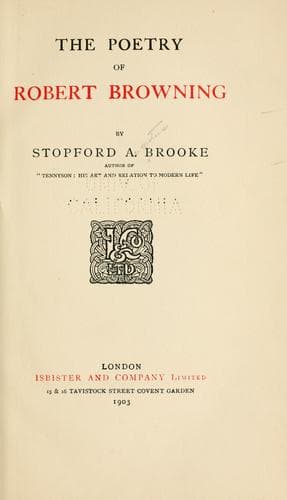
The poetry of Robert BrowningBrooke, Stopford A. (Stopford Augustus)
General
The poetry of Robert Browning
Brooke, Stopford A. (Stopford Augustus)
Browning, Robert, 1812-1889 -- Criticism and interpretation
Browning's method in these poems is the method of a scientific
philosopher, not of an artist. He gets his man into a debateable
situation; the man debates it from various points of view; persons are
introduced who take other aspects of the question, or personified
abstractions such as _Sagacity, Reason, Fancy_ give their opinions. Not
satisfied with this, Browning discusses it again from his own point of
view. He is then like the chess-player who himself plays both red and
white; who tries to keep both distinct in his mind, but cannot help now
and again taking one side more than the other; and who is frequently a
third person aware of himself as playing red, and also of himself as
playing white; and again of himself as outside both the players and
criticising their several games. This is no exaggerated account of what
is done in these poems. Three people, even when the poems are
monologues, are arguing in them, and Browning plays all their hands,
even in _The Inn Album_, which is not a monologue. In _Red Cotton
Nightcap Country_, when he has told the story of the man and woman in
all its sordid and insane detail, with comments of his own, he brings
the victim of mean pleasure and mean superstition to the top of the
tower whence he throws himself down, and, inserting his intelligence
into the soul of the man, explains his own view of the situation. In
_Prince Hohenstiel Schwangau_, we have sometimes what Browning really
thinks, as in the beginning of the poem, about the matter in hand, and
then what he thinks the Prince would think, and then, to complicate the
affair still more, the Prince divides himself, and makes a personage
called _Sagacity_ argue with him on the whole situation. As to _Fifine
at the Fair_--a poem it would not be fair to class altogether with
these--its involutions resemble a number of live eels in a tub of water.
Don Juan changes his personality and his views like a player on the
stage who takes several parts; Elvire is a gliding phantom with gliding
opinions; Fifine is real, but she remains outside of this shifting
scenery of the mind; and Browning, who continually intrudes, is
sometimes Don Juan and sometimes himself and sometimes both together,
and sometimes another thinker who strives to bring, as in the visions
in the poem, some definition into this changing cloudland of the brain.
And after all, not one of the questions posed in any of the poems is
settled in the end. I do not say that the leaving of the questions
unsettled is not like life. It is very like life, but not like the work
of poetry, whose high office it is to decide questions which cannot be
solved by the understanding.
Public-domain text, read in full here on John Shaqi.
Reviews
Reviews
No reviews yet
Be the first to share your thoughts on this work.
Elsewhere in the archive
Join the Discussion
Join the discussion
Sign in to leave a comment or review.
Sign InorCreate an account