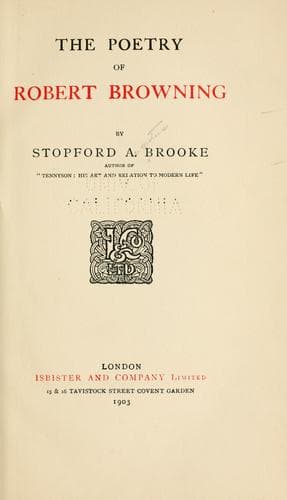
The poetry of Robert BrowningBrooke, Stopford A. (Stopford Augustus)
General
The poetry of Robert Browning
Brooke, Stopford A. (Stopford Augustus)
Browning, Robert, 1812-1889 -- Criticism and interpretation
Yet the poems are not scientific, for they have no clarity of argument.
Their wanderings of thought are as intertangled as the sheep-walks on
league after league of high grasslands. When one has a fancy to follow
them, the pursuit is entertaining; but unless one has the fancy, there
are livelier employments. Their chief interest is the impression they
give us of a certain side of Browning's character. They are his darling
debauch of cleverness, of surface-psychology. The analysis follows no
conventional lines, does not take or oppose any well-known philosophical
side. It is not much more than his own serious or fantastic thinking
indulging itself with reckless abandon--amusing itself with itself. And
this gives them a humanity--a Browning humanity--outside of their
subjects.
The subjects too, though not delightful, are founded on facts of human
life. _Bishop Blougram_ was conceived from Cardinal Wiseman's career,
_Mr. Sludge_ from Mr. Home's. _Prince Hohenstiel Schwangau_ explains and
defends the expediency by which Napoleon III. directed his political
action. _The Inn Album_, _Red Cotton Nightcap Country_, are taken from
actual stories that occurred while Browning was alive, and _Fifine at
the Fair_ analyses a common crisis in the maturer lives of men and
women. The poems thus keep close to special cases, yet--and in this the
poet appears--they have an extension which carries them beyond the
particular subjects into the needs and doings of a wider humanity. Their
little rivers run into the great sea. They have then their human
interest for a reader who does not wish for beauty, passion,
imagination, or the desires of the spirit in his poetry; but who hankers
at his solitary desk after realistic psychology, fanciful ethics,
curiosities of personal philosophy, cold intellectual play with
argument, and honest human ugliness.
Moreover, the method Browning attempts to use in them for the discovery
of truth is not the method of poetry, nor of any of the arts. It is
almost a commonplace to say that the world of mankind and each
individual in it only arrives at the truth on any matter, large or
small, by going through and exhausting the false forms of that
truth--and a very curious arrangement it seems to be. It is this method
Browning pursues in these poems. He represents one after another various
false or half-true views of the matter in hand, and hopes in that
fashion to clear the way to the truth. But he fails to convince partly
because it is impossible to give all or enough of the false or half-true
views of any one truth, but chiefly because his method is one fitted for
philosophy or science, but not for poetry. Poetry claims to see and feel
the truth at once. When the poet does not assert that claim, and act on
it, he is becoming faithless to his art.
Public-domain text, read in full here on John Shaqi.
Reviews
Reviews
No reviews yet
Be the first to share your thoughts on this work.
Elsewhere in the archive
Join the Discussion
Join the discussion
Sign in to leave a comment or review.
Sign InorCreate an account