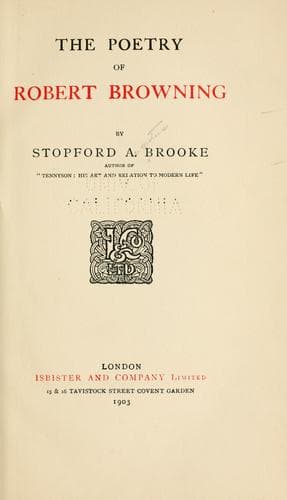
The poetry of Robert BrowningBrooke, Stopford A. (Stopford Augustus)
General
The poetry of Robert Browning
Brooke, Stopford A. (Stopford Augustus)
Browning, Robert, 1812-1889 -- Criticism and interpretation
way; but folk need not call this intellectual jumping to and fro a poem,
or try to induce us to believe that it is the work of art.
When he had finished these products of a time when he was intoxicated
with his intellect, and of course somewhat proud of it, the poet in him
began to revive. This resurrection had begun in _Fifine at the Fair_. I
have said it would not be just to class this poem with the other three.
It has many an oasis of poetry where it is a happiness to rest. But the
way between their palms and wells is somewhat dreary walking, except to
those who adore minute psychology. The poem is pitilessly long. If
throughout its length it were easy to follow we might excuse the length,
but it is rendered difficult by the incessant interchange of misty
personalities represented by one personality. Elvire, Fifine only exist
in the mind of Don Juan; their thoughts are only expressed in his words;
their outlines not only continually fade into his, but his thought
steals into his presentation of their thought, till it becomes
impossible to individualise them. The form in which Browning wrote the
poem, by which he made Don Juan speak for them, makes this want of
clearness and sharpness inevitable. The work is done with a terrible
cleverness, but it is wearisome at the last.
The length also might be excused if the subject were a great one or had
important issues for mankind. But, though it has its interest and is
human enough, it does not deserve so many thousand lines nor so much
elaborate analysis. A few lyrics or a drama of two acts might say all
that is worth saying on the matter. What Browning has taken for subject
is an every-day occurrence. We are grateful to him for writing on so
universal a matter, even though it is unimportant; and he has tried to
make it uncommon and important by weaving round it an intricate
lace-work of psychology; yet, when we get down to its main lines, it is
the ordinary event, especially commonplace in any idle society which
clings to outward respectability and is dreadfully wearied of it. Our
neighbours across the Channel call it _La Crise_ when, after years of a
quiet, not unhappy, excellent married existence, day succeeding day in
unbroken continuity of easy affection and limited experience, the man or
the woman, in full middle life, suddenly wearies of the apparent
monotony, the uneventful love, the slow encroaching tide of the
commonplace, and looks on these as fetters on their freedom, as walls
which shut them in from the vivid interests of the outside world, from
the gipsy roving of the passions. The time arrives, when this becomes,
they think, too great for endurance, and their impatience shows itself
in a daily irritability quite new in the household, apparently
causeless, full of sudden, inexplicable turns of thought and act which
turn the peaceful into a tempestuous home. It is not that the husband or
the wife are inconstant by nature--to call _Fifine at the Fair_ a
Public-domain text, read in full here on John Shaqi.
Reviews
Reviews
No reviews yet
Be the first to share your thoughts on this work.
Elsewhere in the archive
Join the Discussion
Join the discussion
Sign in to leave a comment or review.
Sign InorCreate an account