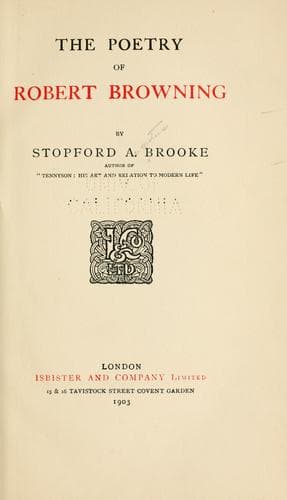
The poetry of Robert BrowningBrooke, Stopford A. (Stopford Augustus)
General
The poetry of Robert Browning
Brooke, Stopford A. (Stopford Augustus)
Browning, Robert, 1812-1889 -- Criticism and interpretation
defence of inconstancy is to lose the truth of the matter--but it is the
desire of momentary change, of a life set free from conventional
barriers, of an outburst into the unknown, of the desire for new
experiences, for something which will bring into play those parts of
their nature of which they are vaguely conscious but which are as yet
unused--new elements in their senses, intellect, imagination, even in
their spirit, but not always in their conscience. That, for the time
being, as in this poem, is often shut up in the cellar, where its voice
cannot be heard.
This is, as I said, a crisis of common occurrence. It may be rightly
directed, its evil controlled, and a noble object chosen for the
satisfaction of the impulse. Here, that is not the case; and Browning
describes its beginning with great freshness and force as Juan walks
down to the fair with Elvire. Nor has he omitted to treat other forms of
it in his poetry. He knew how usual it was, but he has here made it
unusual by putting it into the heart of a man who, before he yielded to
it, was pleased to make it the subject of a wandering metaphysical
analysis; who sees not only how it appears to himself in three or four
moods, but how it looks to the weary, half-jealous wife to whom he is so
rude while he strives to be courteous, and to the bold, free,
conscienceless child of nature whose favour he buys, and with whom,
after all his barren metaphysics, he departs, only to attain, when his
brief spell of foolish freedom is over, loneliness and cynic satiety. It
may amuse us to circle with him through his arguments, though every one
knows he will yield at last and that yielding is more honest than his
talk; but what we ask is--Was the matter worth the trouble of more than
two thousand lines of long-winded verse? Was it worth an artist's
devotion? or, to ask a question I would not ask if the poem were good
art, is it of any real importance to mankind? Is it, finally, anything
more than an intellectual exercise of Browning on which solitary
psychologists may, in their turn, employ their neat intelligence? This
poem, with the exceptions of some episodes of noble poetry, is, as well
as the three others, a very harlequinade of the intellect.
I may say, though this is hypercritical, that the name of Don Juan is a
mistake. Every one knows Don Juan, and to imagine him arguing in the
fashion of this poem is absurd. He would instantly, without a word, have
left Elvire, and abandoned Fifine in a few days. The connection then of
the long discussions in the poem with his name throws an air of
unreality over the whole of it. The Don Juan of the poem had much better
have stayed with Elvire, who endured him with weary patience. I have no
doubt that he bored Fifine to extinction.
Public-domain text, read in full here on John Shaqi.
Reviews
Reviews
No reviews yet
Be the first to share your thoughts on this work.
Elsewhere in the archive
Join the Discussion
Join the discussion
Sign in to leave a comment or review.
Sign InorCreate an account