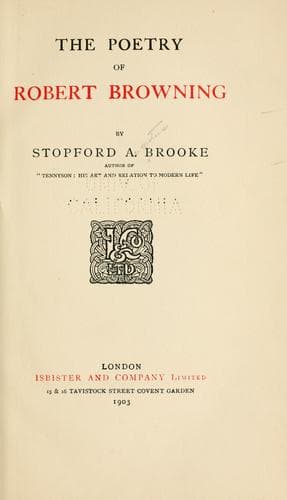
The poetry of Robert BrowningBrooke, Stopford A. (Stopford Augustus)
General
The poetry of Robert Browning
Brooke, Stopford A. (Stopford Augustus)
Browning, Robert, 1812-1889 -- Criticism and interpretation
This, which Browning puts on the lips of another, is not meant, we are
told, to describe himself. But it does describe one side of him very
well, and the origin and conduct of a number of his earlier poems. But
now, having changed his manner, even the principles of his poetry, he
describes himself as different from that--as a sterner, more iron poet,
and the work he now does as more likely to endure, and be a power in the
world of men. He was curiously mistaken.
Indeed, he cries, is that the soil in which a poet grows?
"Rock's the song-soil rather, surface hard and bare:
Sun and dew their mildness, storm and frost their rage
Vainly both expend,--few flowers awaken there:
Quiet in its cleft broods--what the after-age
Knows and names a pine, a nation's heritage."
In this sharp division, as in his _Epilogue_ to _Pacchiarotto_, he
misses the truth. It is almost needless to say that a poet can be
sensitive to beauty, and also to the stern facts of the moral and
spiritual struggle of mankind through evil to good. All the great poets
have been sensitive to both and mingled them in their work. They were
ideal and real in both the flower and the pine. They are never forced
to choose one or other of these aims or lives in their poetry. They
mingled facts and fancies, the intellectual and the imaginative. They
lived in the whole world of the outward and the inward, of the senses
and the soul. Truth and beauty were one to them. This division of which
Browning speaks Was the unfortunate result of that struggle between his
intellect and his imagination on which I have dwelt. In old days it was
not so with him. His early poetry had sweetness with strength, stern
thinking with tender emotion, love of beauty with love of truth,
idealism with realism, nature with humanity, fancy with fact. And this
is the equipment of the great poet. When he divides these qualities each
from the other, and is only æsthetic or only severe in his realism; only
the worshipper of Nature or only the worshipper of human nature; only
the poet of beauty or only the poet of austere fact; only the idealist
or only the realist; only of the senses or only of the soul--he may be a
poet, but not a great poet. And as the singular pursuit of the realistic
is almost always bound up with pride, because realism does not carry us
beyond ourselves into the infinite where we are humbled, the realistic
poetry loses imagination; its love of love tends to become self-love, or
love of mere cleverness. And then its poetic elements slowly die.
Public-domain text, read in full here on John Shaqi.
Reviews
Reviews
No reviews yet
Be the first to share your thoughts on this work.
Elsewhere in the archive
Join the Discussion
Join the discussion
Sign in to leave a comment or review.
Sign InorCreate an account