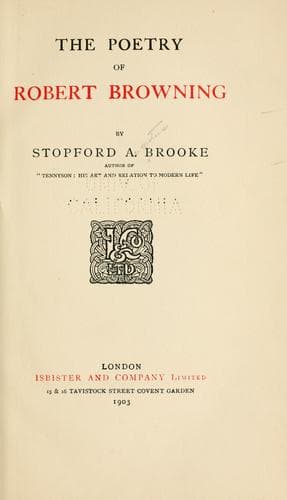
The poetry of Robert BrowningBrooke, Stopford A. (Stopford Augustus)
General
The poetry of Robert Browning
Brooke, Stopford A. (Stopford Augustus)
Browning, Robert, 1812-1889 -- Criticism and interpretation
He lost himself more completely in this error in _Parleyings with
Certain People_, in which book, with the exception of the visionary
landscapes in _Gerard de Lairesse_, and some few passages in _Francis
Furini_ and _Charles Avison_, imagination, such as belongs to a poet,
has deserted Browning. He feels himself as if this might be said of
him; and he asks in _Gerard de Lairesse_ if he has lost the poetic
touch, the poetic spirit, because he writes of the soul, of facts, of
things invisible--not of fancy's feignings, not of the things perceived
by the senses? "I can do this," he answers, "if I like, as well as you,"
and he paints the landscape of a whole day filled with mythological
figures. The passage is poetry; we see that he has not lost his poetic
genius. But, he calls it "fooling," and then contrasts the spirit of
Greek lore with the spirit of immortal hope and cheer which he
possesses, with his faith that there is for man a certainty of Spring.
But that is not the answer to his question. It only says that the spirit
which animates him now is higher than the Greek spirit. It does not
answer the question--Whether _Daniel Bartoli_ or _Charles Avison_ or any
of these _Parleyings_ even approach as poetry _Paracelsus_, the
_Dramatic Lyrics_, or _Men and Women_. They do not. Nor has their
intellectual work the same force, unexpectedness and certainty it had of
old. Nevertheless, these _Parleyings_, at the close of the poet's life,
and with biographical touches which give them vitality, enshrine
Browning's convictions with regard to some of the greater and lesser
problems of human life. And when his personality is vividly present in
them, the argument, being thrilled with passionate feeling, rises, but
heavily like a wounded eagle, into an imaginative world.
The sub-consciousness in Browning's mind to which I have alluded--that
these later productions of his were not as poetical as his earlier work
and needed defence--is the real subject of a remarkable little poem at
the end of the second volume of the _Dramatic Idyls_. He is thinking of
himself as poet, perhaps of that double nature in him which on one side
was quick to see and love beauty; and on the other, to see facts and
love their strength. Sometimes the sensitive predominated. He was only
the lover of beauty whom everything that touched him urged into song.
"Touch him ne'er so lightly, into song he broke:
Soil so quick-receptive,--not one feather-seed,
Not one flower-dust fell but straight its fall awoke
Vitalising virtue: song would song succeed
Sudden as spontaneous--prove a poet-soul!"
Public-domain text, read in full here on John Shaqi.
Reviews
Reviews
No reviews yet
Be the first to share your thoughts on this work.
Elsewhere in the archive
Join the Discussion
Join the discussion
Sign in to leave a comment or review.
Sign InorCreate an account