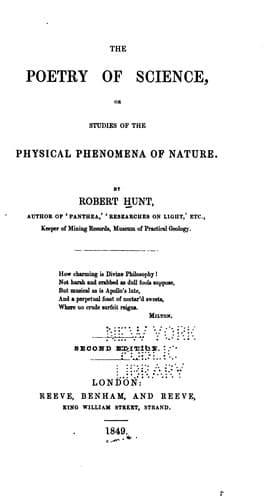
The Poetry of Science; or, Studies of the Physical Phenomena of NatureHunt, Robert
Philosophy
The Poetry of Science; or, Studies of the Physical Phenomena of Nature
Hunt, Robert
Physics; Science
Light, the first creation, presents to the enquiring mind a series
of phenomena of the most exalted character. The glowing sunshine,
painting the earth with all the brilliancy of colour, and giving to the
landscape the inimitable charm of every degree of illumination, from
the grey shadow to the golden glow;--the calm of evening, when, weary
of the “excess of splendour,” the eye can repose in tranquillity upon
the “cloud-land” of the west, and watch the golden and the ruddy hues
fade slowly into the blue tincture of night;--and the pale refulgence
of the moon, with the quiet sparkle of the sun-lit stars,--all tend
to impress upon the soul, the great truth that, where there is light,
organisation and life are found, and beyond its influence death and
silence hold supreme dominion.[84] Through all time we have evidences
that this has been the prevailing feeling of the human race, derived,
of course, from their observation of the natural phenomena dependent
upon luminous agency. In the myths of every country, impersonations of
light prevail, and to these are referred the mysteries of the perpetual
renewal of life on the surface of the earth.
This presentiment of a philosophic truth, in the instance of the poet
sages of intellectual Greece, was advanced to the highest degree of
refinement; and the sublime exclamation of Plato: “Light is truth, and
God is light,” approaches nearly to a divine revelation.
As the medium of vision--as the cause of colour--as a power influencing
in a most striking manner all the forms of organisation around us,
light presented to the inquiring minds of all ages a subject of the
highest interest.
The ancient philosophers, although they lost themselves in the
metaphysical subtleties of their schools, could not but discover in
light an element of the utmost importance in natural operations. The
alchemists regarded the luminous principle as a most subtile fluid,
capable of interpenetrating and mingling with gross matter: gold
being supposed to differ from the baser metals only in containing a
larger quantity of this ethereal essence.[85] Modern science, after
investigating most attentively a greater number of the phenomena of
light, has endeavoured to assist the inquiry by the aid of hypotheses.
Newton, in a theory, which exhibits the refined character of that
great philosopher’s mind, supposes luminous particles to dart from the
surfaces of bodies in all directions--that these infinitely minute
particles are influenced by the attracting and repelling forces of
matter, and thus turned back, or reflected, from their superficies in
some cases, and absorbed into their interstitial spaces in others.
Public-domain text, read in full here on John Shaqi.
Reviews
Reviews
No reviews yet
Be the first to share your thoughts on this work.
Elsewhere in the archive
Join the Discussion
Join the discussion
Sign in to leave a comment or review.
Sign InorCreate an account