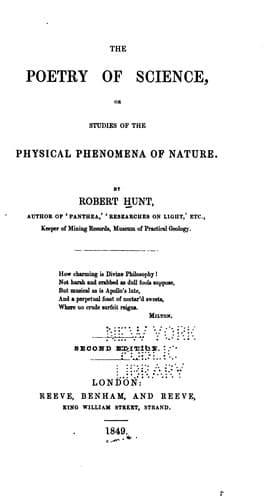
The Poetry of Science; or, Studies of the Physical Phenomena of NatureHunt, Robert
Philosophy
The Poetry of Science; or, Studies of the Physical Phenomena of Nature
Hunt, Robert
Physics; Science
Huyghens, on the contrary, supposes light to be caused by the waves or
vibrations of an infinitely elastic medium--ETHER--diffused through all
space, which waves are propagated in every direction from the luminous
body. In the first theory, a luminous particle is supposed actually to
come from the sun to the earth; in the other, the sun only occasions a
disturbance of the _ether_, which extends with great rapidity, in the
same manner as a wave spreads itself over the surface of a lake.
Nearly all the facts known in the time of Newton, and those discovered
by him, were explained most satisfactorily by his hypothesis; but
it was found they could be interpreted equally as the effects of
undulation, with the exception of the production of colour by prismatic
refraction. Although the labours of many gifted minds have been given,
with the utmost devotion, to the support of the vibratory theory,
this simple fact has never yet received any satisfactory explanation;
and there are numerous discoveries connected with the molecular and
chemical disturbances produced by the sun’s rays, which do not appear
to be explained by the hypothesis of emission or of undulation.
In both theories a wave motion is admitted, and every fact renders
it probable that this mode of progression applies not only to light,
but to the so-called _imponderable forces_ in general. Admitting,
therefore, the undulatory movement of luminous rays, we shall not stop
to consider those points of the discussion which have been so ably
dealt with by Young, Laplace, Fresnel, Biot, Fraunhofer, Herschel,
Brewster, and others, but proceed at once to consider the sources of
light, and its more remarkable phenomena.[86]
The sun is the greatest permanently luminous body we are acquainted
with, and that orb is continually pouring off light from its surface
in all directions at the rate, through the resisting medium of space
and of our own atmosphere, of 192,000 miles in a second of time. It has
been calculated, however, that light would move through a vacuum with
the speed of 192,500 miles in the same period. We, therefore, learn
that a ray of light requires eight minutes and thirteen seconds to
come from the sun to us. In travelling from the distant planet Uranus,
nearly three hours are exhausted; and from the nearest of the fixed
stars each ray of light requires more than six years to traverse the
intervening space between it and the earth. Allow the mind to advance
to the regions of nebulæ, and it will be found that hundreds of years
must glide away during the passage of their radiations. Consequently,
if one of those masses of matter, or even one of the remote fixed
stars, was “blotted out of heaven” to-day, several generations of
the finite inhabitants of this world would fade out of time before
the obliteration could be known to man. Here the immensity of space
assists us in our conception, limited though it be, of the for-ever of
eternity.[87]
Public-domain text, read in full here on John Shaqi.
Reviews
Reviews
No reviews yet
Be the first to share your thoughts on this work.
Elsewhere in the archive
Join the Discussion
Join the discussion
Sign in to leave a comment or review.
Sign InorCreate an account