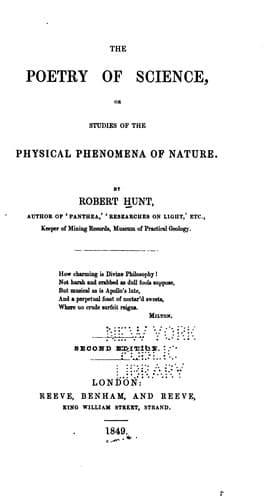
The Poetry of Science; or, Studies of the Physical Phenomena of NatureHunt, Robert
Philosophy
The Poetry of Science; or, Studies of the Physical Phenomena of Nature
Hunt, Robert
Physics; Science
If a body sends back white light unchanged, it appears white; if the
surface has the property of altering the vibration to that degree which
is calculated to produce redness, the result is a red colour: the
annihilation of the undulations produces blackness. By the other view,
or the corpuscular hypothesis, the beam of white light is supposed to
consist of certain coloured rays, each of which has physical properties
peculiar to itself, and thus is capable of producing different
physiological effects. These rays falling upon a transparent or an
opaque body suffer more or less absorption, and being thus dissevered,
we have the effect of colour. A red body absorbs all the rays but the
red; a blue surface, all but the blue; a yellow, all but the yellow;
and a black surface absorbs the whole of the light which falls upon it.
That natural colours are the result of white light, and not innate
properties of the bodies themselves, is most conclusively shown by
placing coloured bodies in monochromatic light of another kind, when
they will appear either of the colour of that light, or, by absorbing
it, become black; whereas, when placed in light of their own character,
the intensity of colour is greatly increasing.
Every surface has, therefore, a peculiar constitution, by which it
gives rise to the diversified hues of nature. The rich and lively
green, which so abundantly overspreads the surface of the earth, the
varied colours of the flowers, and the numberless tints of animals,
together with all those of the productions of the mineral kingdom,
and of the artificial combinations of chemical manufacture, result
from powers by which the relations of matter to light are rendered
permanent, until its physical conditions undergo some change.
There is a remarkable correspondence between the geographical position
of a region and the colours of its plants and animals. Within the
tropics, where
“The sun shines for ever unchangeably bright,”
the darkest green prevails over the leaves of plants; the flowers
and fruits are tinctured with colours of the deepest dye, whilst the
plumage of the birds is of the most variegated description and of the
richest hues. In the people also of these climes there is manifested
a desire for the most striking colours, and their dresses have all
a distinguishing character, not of shape merely, but of chromatic
arrangement. In the temperate climates everything is of a more subdued
variety: the flowers are less bright of hue; the prevailing tint of the
winged tribes is a russet brown; and the dresses of the inhabitants of
these regions are of a sombre character. In the colder portions of the
earth there is but little colour; the flowers are generally white or
yellow, and the animals exhibit no other contrast than that which white
and black afford. A chromatic scale might be formed, its maximum point
being at the equator, and its minimum at the poles.[94]
Public-domain text, read in full here on John Shaqi.
Reviews
Reviews
No reviews yet
Be the first to share your thoughts on this work.
Elsewhere in the archive
Join the Discussion
Join the discussion
Sign in to leave a comment or review.
Sign InorCreate an account