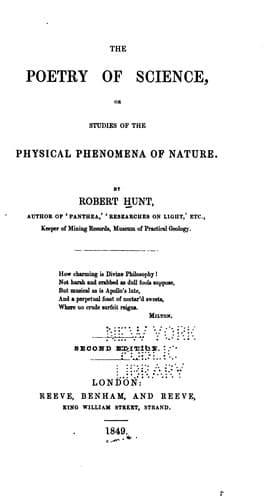
The Poetry of Science; or, Studies of the Physical Phenomena of NatureHunt, Robert
Philosophy
The Poetry of Science; or, Studies of the Physical Phenomena of Nature
Hunt, Robert
Physics; Science
have the power of producing chemical changes, such as are rendered
familiar by the practice of Photography, are detected in their greatest
activity. It has, therefore, been supposed that these fluorescent rays
are the chemical rays rendered luminous by the alteration of their
refrangibility. This view has received much support from the fact that
the extra spectral rays are crossed with numerous dark lines, and that
in the chemical impressions these lines are marked by unchanged spaces
which exactly coincide with them. There is, however, much doubt of the
correctness of this, since, in the uranium glass of such a thickness
that these visible rays are quite absorbed, the chemical rays still
pass.
However, the whole question requires, and is receiving, the most
searching investigation. The discovery of these phenomena, which are
included under the term of Fluorescence, is of that interesting and
important character, that it must be ranked as the most decided advance
which has been made in physical optics since the days of Newton.
It is not improbable that those rays of such high refrangibility may,
although they are under ordinary circumstances invisible to the human
eye, be adapted to produce the necessary degree of excitement upon
which vision depends in the optic nerves of the night-roaming animals.
The bat, the owl, and the cat, may see in the gloom of night by the aid
of rays which are invisible to, or inactive on the eyes of man, or of
those animals which require the light of day for perfect vision.
It is a general law of the radiant forces, that whenever they fall upon
any surface, a portion is thrown back or reflected at the same time
as other portions are absorbed or transmitted. Upon this peculiarity
appear to depend the phenomena of natural colour in bodies.
The white light of the sun is well known to be composed of several
coloured rays. Or rather, according to the theory of undulations, when
the rate at which a ray vibrates is altered, a different sensation
is produced upon the optic nerve. The analytical examination of
this question shows, that to produce a red colour the ray of light
must give 37,640 undulations in an inch, and 458,000000,000000 in
a second. Yellow light requires 44,000 undulations in an inch, and
535,000000,000000 in a second; whilst the effect of blue results from
51,110 undulations within an inch, and 622,000000,000000 of waves in
a second of time.[93] The determination of such points as these is
among the highest refinements of science, and, when contrasted with the
most sublime efforts of the imagination, they must appear immeasurably
superior.
Public-domain text, read in full here on John Shaqi.
Reviews
Reviews
No reviews yet
Be the first to share your thoughts on this work.
Elsewhere in the archive
Join the Discussion
Join the discussion
Sign in to leave a comment or review.
Sign InorCreate an account