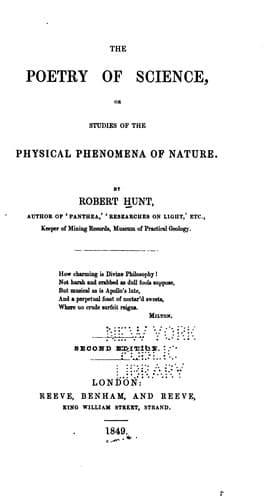
The Poetry of Science; or, Studies of the Physical Phenomena of NatureHunt, Robert
Philosophy
The Poetry of Science; or, Studies of the Physical Phenomena of Nature
Hunt, Robert
Physics; Science
The polarization of light, as it has been unfortunately
called--unfortunately, as conveying an idea of determinate and
different points or poles, which only exists in hypothetical
analogy--presents to us a class of phenomena which promise to unclose
the mysterious doors of the molecular constitution of bodies.
This remarkable condition, as produced by the reflection of light from
glass at a particular angle, was first observed by Malus, in 1808,[99]
when amusing himself by looking at the beams of the setting sun,
reflected from the windows of the Luxembourg Palace through a double
refracting prism. He observed that when the prism was in one position,
the windows with their golden rays were visible; but that turned
round a quarter of a circle from that position, the reflected rays
disappeared although the windows were still seen.
The phenomenon of double refraction was noticed, in the first instance,
by Erasmus Bartholin, in Iceland-spar, a crystal the primary form of
which is a rhombohedron; who perceived that the two images produced by
this body were not in the same physical conditions.[100] It was also
studied by Huyghens and Sir Isaac Newton, and to our countryman we owe
the singular idea that a ray of light emerging from such a crystal
has _sides_. This breaking up of the beam of light into two,--which
is shown by looking through a pin-hole on a card through a crystal of
Iceland spar, when two holes become visible, is due to the different
states of tension in which the different layers constituting the
crystal exist.
In thus separating the ray of light into two rays, the condition
called polarisation has been produced, and by experiment we discover
that the single ray has properties different from those of the compound
or ordinary ray.
It is somewhat difficult to explain what is meant by, and what are the
conditions of, _polarised light_. In the first instance let us see by
what methods this peculiar state may be brought about.
If we reflect a ray of light from the surface of any body, fluid or
solid, but not metallic, at an angle between 53° and 68° it undergoes
what has been called _plane polarisation_. It may also be produced by
the refraction of light from several refracting surfaces acting upon
the pencil of light in succession; as by a bundle of plates of glass.
Each surface polarises a portion of the pencil, and the number of
plates necessary to polarise a whole beam depends upon the intensity of
the beam and the angle of incidence. Thus, the light of a wax candle
is wholly polarised by forty-seven plates of glass at an angle of 40°
41'; while at an angle of 79° 11' it is polarised by eight plates.
Again, plane polarisation may be produced by the double refraction of
crystals. Each of the two pencils is polarised, like light reflected
from glass at an angle of 56° 45', but in opposite planes.
Public-domain text, read in full here on John Shaqi.
Reviews
Reviews
No reviews yet
Be the first to share your thoughts on this work.
Elsewhere in the archive
Join the Discussion
Join the discussion
Sign in to leave a comment or review.
Sign InorCreate an account