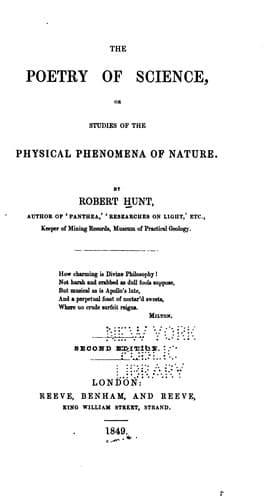
The Poetry of Science; or, Studies of the Physical Phenomena of NatureHunt, Robert
Philosophy
The Poetry of Science; or, Studies of the Physical Phenomena of Nature
Hunt, Robert
Physics; Science
Non-scientific readers will still ask,--What is this mysterious
condition of light which is produced by reflection and refraction at
peculiar angles to the incident ray. It is one of the most difficult of
problems to express in popular language. The conditions are, however,
these:--
An ordinary ray of light will be reflected from a reflecting surface at
whatever angle that surface may be placed in relation to the incident
beam.
A polarised ray of light is not reflected in all positions of the
reflecting surface.
An ordinary ray of light is freely transmitted through a transparent
medium, as glass, in whatever position it may be placed relative to the
source of light.
A polarised ray of light is not transmitted in all the positions of the
permeable medium.
Supposing a plate of glass is presented at the angle 56° to a polarised
ray, and the plane of incidence or reflexion is at right angles to the
plane of polarisation of the ray, _no light is reflected_. If we turn
the plate of glass round through 90°, when the plane of reflexion is
parallel to that of polarisation _the light is reflected_. If we turn
the plate round another 90°, so that the plane of reflexion and of
polarisation are parallel to each other, again _no light is reflected_;
and if we turn it through another 90° the reflection of the ray again
takes place.
Precisely the same result takes place when, instead of being reflected,
the polarised ray is transmitted.
Some substances have peculiar polarizing powers: _the tourmaline_ is a
familiar example. If a slice of tourmaline is taken, and we look at a
common pencil of light through it, we see it in whatever position we
may place the transparent medium. If, however, we look at a pencil of
polarised light, and turn the crystal round, it will be found that in
two positions the light is stopped, and that in two other positions it
passes freely through it to the eye.
By way of endeavouring to conceive something of what may be the
conditions which determine this very mysterious state, let us suppose
each ray of light to vibrate in two planes at right angles to each
other: one wave being vertical and the other horizontal. We have many
examples of this compound motion. The mast of a ship, by the force with
which she is urged through the water, describes a vertical wave, while
by the roll of the billows across which she sails, a lateral undulation
is produced at the same time. We may sometimes observe the same thing
when a field of corn is agitated by a shifting wind on a gusty day.
The hypothesis therefore is, that every ray of ordinary light consists
of two rays vibrating in different planes; and that these rays,
separated one from the other, have the physical conditions which we
call _polarized_.
Public-domain text, read in full here on John Shaqi.
Reviews
Reviews
No reviews yet
Be the first to share your thoughts on this work.
Elsewhere in the archive
Join the Discussion
Join the discussion
Sign in to leave a comment or review.
Sign InorCreate an account