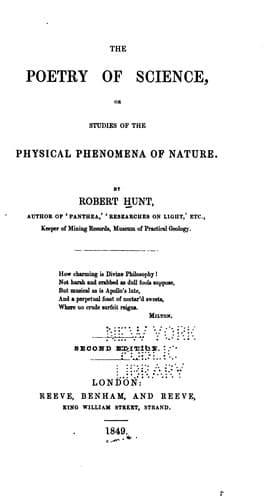
The Poetry of Science; or, Studies of the Physical Phenomena of NatureHunt, Robert
Philosophy
The Poetry of Science; or, Studies of the Physical Phenomena of Nature
Hunt, Robert
Physics; Science
The most transparent bodies may be regarded as being made up of atoms
arranged in certain planes. Suppose the plane of lamination of any
substance to be vertical in position, it would appear that the ray
which has a vertical motion passes it freely, whereas if we turn the
body round so that the planes of lamination are at right angles to the
plane of vibration of the ray, it cannot pass.
That some action similar to that which it is here endeavoured to
express in popular language does take place, is proved by the
correctness of the results deduced by rigid mathematical analyses
founded on this hypothesis.
There are two other conditions of the polarization of light--called
_circular_ and _elliptical_ polarization. The first is produced by
light when it is twice reflected from the second surface of bodies at
their angle of maximum polarization, and the second by reflexions from
the surfaces of metals at angles varying from 70° 45' to 78° 30'. The
motion of the wave in the first is supposed to be circular, or to be
that which is represented by looking along the centre of a corkscrew
as it is turned round. At every turn of the medium effecting _circular
polarization_ the colour of the ray of light is changed after a uniform
order. If turned in one direction, they change through red, orange,
yellow, green, and violet; and if in the other direction, the colours
appear in the contrary order.
The variety of striking effects produced by the polarization of light;
the unexpected results which have sprung from the investigation of the
laws by which it is regulated; and the singular beauty of many of its
phenomena, have made it one of the most attractive subjects of modern
science.
Ordinary light passes through transparent bodies without producing any
very striking effects in its passage; but this _extraordinary_ beam
of light has the power of insinuating itself between the molecules
of bodies, and by illuminating them, and giving them every variety
of prismatic hue, of enabling the eye to detect something of the
structure of the mass. The chromatic phenomena of polarized light are
so striking, that no description can convey an adequate idea of their
character.
Spectra more beautiful and intense than the prismatic image,--systems
of rings far excelling those of thin plates,--and forms of the most
symmetric order, are constantly presenting themselves, as the polarized
ray is passed through various transparent substances; the path of the
ray indicating whether the crystal has been formed round a single
nucleus or axis, or whether it has been produced by aggregation
around two axes. The coloured rings, and the dark or luminous crosses
which distinguish the path of the polarized ray, are respectively
due to different states of tension amongst the particles, although
those differences are so slight, that no other means is of sufficient
delicacy to detect the variation.
Public-domain text, read in full here on John Shaqi.
Reviews
Reviews
No reviews yet
Be the first to share your thoughts on this work.
Elsewhere in the archive
Join the Discussion
Join the discussion
Sign in to leave a comment or review.
Sign InorCreate an account