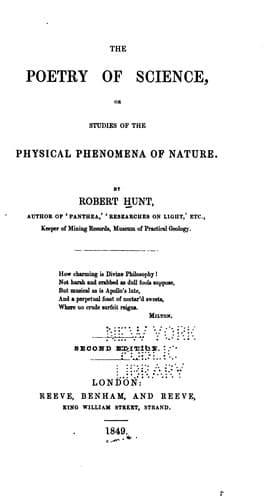
The Poetry of Science; or, Studies of the Physical Phenomena of NatureHunt, Robert
Philosophy
The Poetry of Science; or, Studies of the Physical Phenomena of Nature
Hunt, Robert
Physics; Science
“It is the boast of science to have been able to trace so far the
refined contrivances of this most admirable organ, not its shame to
find something still concealed from scrutiny; for, however anatomists
may differ on points of structure, or physiologists dispute on modes
of action, there is that in what we _do_ understand of the formation
of the eye, so similar, and yet so infinitely superior to a product
of human ingenuity; such thought, such care, such refinement, such
advantage taken of the properties of natural agents used as mere
instruments for accomplishing a given end, as force upon us a
conviction of deliberate choice and premeditated design, more strongly,
perhaps, than any single contrivance to be found whether in art or
nature, and renders its study an object of the greatest interest.”[107]
Has the reader ever asked himself why it is, having two eyes, and
consequently two pictures produced upon the tablets of vision, that we
see only one object? According to the law of visible direction, all the
rays passing through the crystalline lenses converge to one point upon
the retina,--and as the two images are coincident and nearly identical,
they can only produce the sensation of one upon the brain.
When we look at any round object, as the ornamented moderator lamp
before us, first with one eye, and then with the other, we discover
that, with the right eye, we see most of the right-hand side of the
lamp, and with the left eye more of the left-hand side. These two
images are combined, and we see an object which we know to be round.
This is illustrated in a most interesting manner by the little optical
instrument, _the Stereoscope_. It consists either of two mirrors placed
each at an angle of 45°, or of two semi-lenses turned with their curved
sides towards each other. To view its phenomena, two pictures are
obtained by the camera obscura on photographic paper of any object in
two positions, corresponding with the conditions of viewing it with the
two eyes. By the mirrors or the lenses these dissimilar pictures are
combined within the eye, and the vision of an actually solid object is
produced from the pictures represented on a plane surface. Hence the
name of the instrument; which signifies, _Solid I see_.
Analogy is often of great value in indicating the direction in which to
seek for a truth; but analogical evidence, unless where the resemblance
is very striking, should be received with caution. Mankind are so ready
to leap to conclusions without the labour necessary for a faithful
elucidation of the truth, that too often a few points of resemblance
are seized upon, and an inference is drawn which is calculated to
mislead.
Public-domain text, read in full here on John Shaqi.
Reviews
Reviews
No reviews yet
Be the first to share your thoughts on this work.
Elsewhere in the archive
Join the Discussion
Join the discussion
Sign in to leave a comment or review.
Sign InorCreate an account