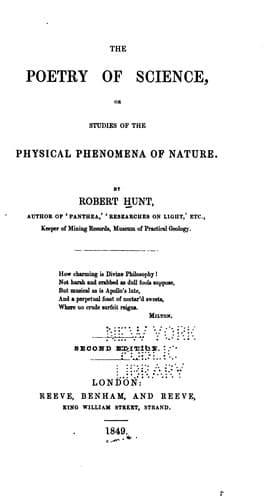
The Poetry of Science; or, Studies of the Physical Phenomena of NatureHunt, Robert
Philosophy
The Poetry of Science; or, Studies of the Physical Phenomena of Nature
Hunt, Robert
Physics; Science
There is an idea that the phenomena of sound bear a relation to those
of light,--that there exists a resemblance between the chromatic
and the diatonic scales. Sound, we know, is conveyed by the beating
of material particles--the air--upon the auditory membrane of the
ear, which have been set in motion by some distant disturbance of
the medium through which it passes. Light has been supposed to act
on the optic nerve in the same manner. If we imagine colour to be
the result of vibrations of different velocities and lengths, we can
understand that under some of these tremors, first established on the
nerves, and through them conveyed to the brain, sensations of pain
or pleasure may result, in the same way as sharp or subdued sounds
are disagreeable or otherwise. Intensely coloured bodies do make an
impression upon perfectly blind men; and those who, being born blind,
know no condition of light or colour, will point out a difference
between strongly illuminated red and yellow media. When the eyes are
closed we are sensible to luminous influence, and even to differences
of colour. We must consequently infer that light produces some peculiar
action upon the system of nerves in general; this may or may not
be independent of the chemical agency of the solar radiations; but
certainly the excitement is not owing to any calorific influence. The
system of nerves in the eye is more delicately organized, and of course
peculiarly adapted to all the necessities of vision.
Thus far some analogy does appear to exist between light and sound;
but the phenomena of the one are so much more refined than those of
the other--the impressions being all of them of a far more complicated
character, that we must not be led too far by the analogical evidence
in referring light, like sound, to mere material motion.
It was a beautiful idea that real impressions of external objects
are made upon the seat of vision, and that they are viewed, as in a
picture, by something behind the screen,--that these pictures become
dormant, but are capable of being revived by the operations of the mind
in peculiar conditions; but we can only regard it as a philosophical
speculation of a poetic character, the truth or falsehood of which we
are never likely to be enabled to establish.[108]
That which sees will never itself be visible. The secret principle
of sensation,--the mystery of the life that is in us,--will never be
unfolded to finite minds.
Public-domain text, read in full here on John Shaqi.
Reviews
Reviews
No reviews yet
Be the first to share your thoughts on this work.
Elsewhere in the archive
Join the Discussion
Join the discussion
Sign in to leave a comment or review.
Sign InorCreate an account